
Why do we take so many photos we never look at again?
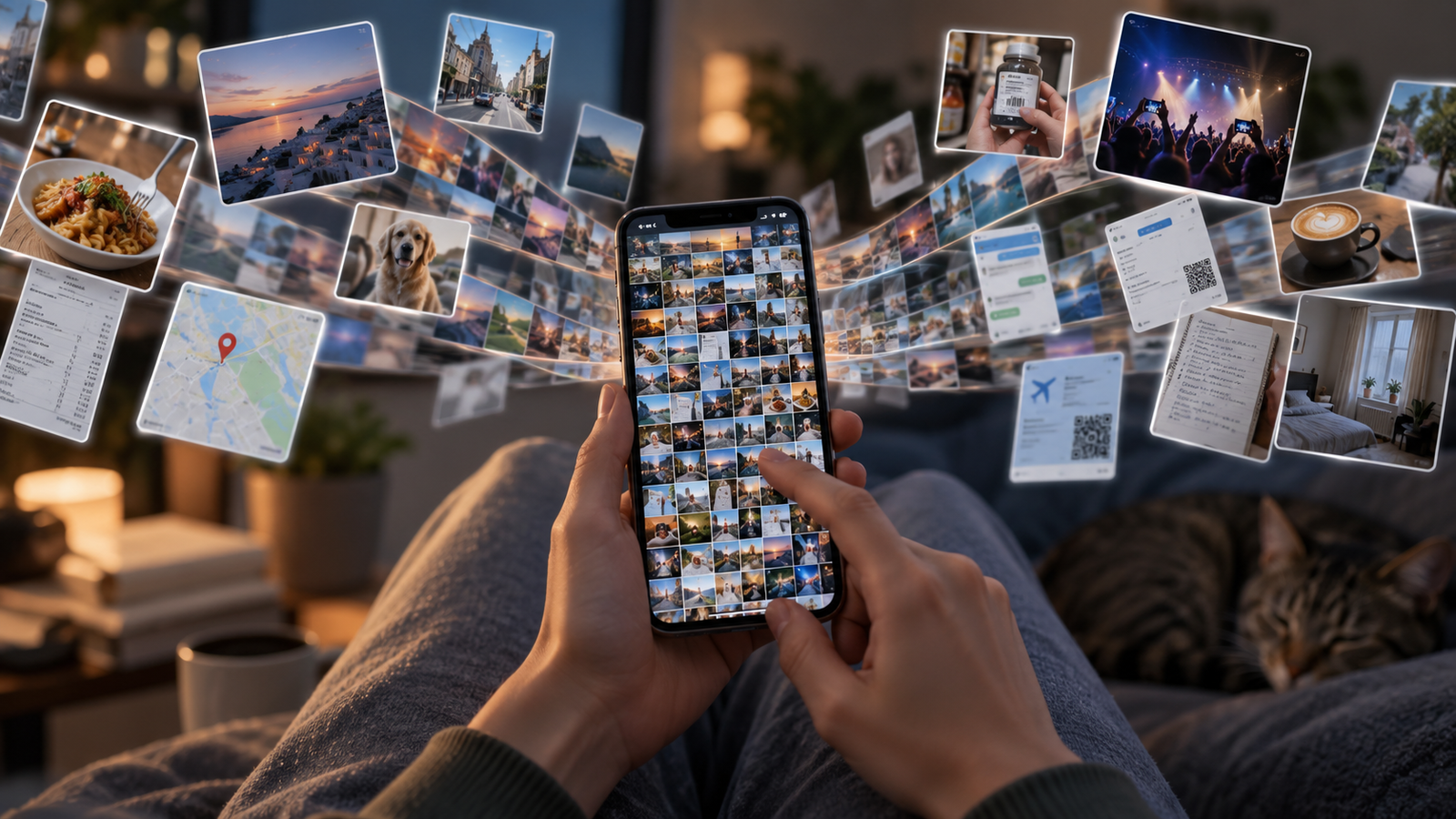
Open your phone’s photo gallery and start scrolling back: yesterday, last week, three months ago, last year. Eventually, you’ll find Photos We Never Look At Again — three nearly identical pictures of a meal, a screenshot you meant to check later, a random street, a product in a store, ten versions of the same sunset, or dozens of photos from an evening you already remember perfectly well.
Some images matter. Many probably never will. Yet we keep taking them.
Smartphones have made cameras always available, increasingly capable and virtually unlimited for everyday use. Taking another photo requires almost no effort or immediate cost. Photography has therefore shifted from an occasional act of selection to something closer to a continuous record of everyday life.
That creates an interesting contradiction: we have never taken more photographs, yet many may never receive our attention again.
Athens Pulse examines why we take so many photos we never look at again, what happens when capturing a moment becomes easier than deciding whether it deserves to be captured, and whether the modern camera roll is still mainly a collection of memories — or something entirely different.
Photography Used to Require a Decision
For most of photography’s history, taking a picture involved some form of limitation.
Film had a finite number of exposures. Developing photographs cost money. Cameras were separate objects that people had to remember to carry. Even early digital cameras had relatively limited storage.
Every photograph therefore carried a small decision:
Is this worth taking?
That did not mean every analogue photograph was meaningful or well composed. People still took bad pictures, accidental pictures and multiple versions of the same scene.
But scarcity created friction.
Today, much of that friction has disappeared.
Our camera is already in our pocket. Storage is enormous compared with the number of photographs most people could realistically take in a day. Cloud services can expand that capacity further. Taking five versions instead of one requires only a few additional taps.
The question has quietly changed from “Is this worth photographing?” to “Why not take a photo?”
And that small reversal has enormous consequences.
When the Cost Approaches Zero, We Stop Choosing
Imagine having only 24 photographs available during a week-long trip.
You would probably think before pressing the shutter. Which moments deserve one of those limited exposures? Do you really need four photographs of breakfast?
Now imagine having effectively thousands available.
The incentive to choose carefully disappears.
If one photograph might be blurry, take five. If you cannot decide which angle looks better, photograph all of them. If something might be useful later, take a picture and worry about it then.
This is not necessarily irrational. When the perceived cost of another photograph is almost zero, taking too many can feel safer than taking too few.
The economic consequences of this transition are broader than photography itself. Market Insiders will explore this in “The Economics of Unlimited Photography: What Changes When Taking One More Photo Costs Almost Nothing?”, examining how behavior changes when the marginal cost of producing another digital object becomes almost negligible.
For the individual user, however, the result is simple: the cost of capturing has fallen much faster than our ability — or willingness — to curate what we capture.
The Camera Roll Is No Longer Just a Photo Album
There is another reason we accumulate so many photographs.
Not everything in our gallery was taken because we wanted to preserve a memory.
We photograph a parking location so we can find the car later. A product label so we can search for it online. A restaurant menu to send to someone. A document because scanning it is inconvenient. A Wi-Fi password. A price in a shop. A timetable. A receipt.
Then there are screenshots.
Messages, maps, products, memes, posts, tickets, QR codes and pieces of information we might need later all end up beside photographs of birthdays and holidays.
The modern camera roll has therefore become something strange.
Part photo album.
Part notebook.
Part archive.
Part visual reminder system.
Part temporary storage.
And the phone generally keeps all of it.
A photograph does not need to be emotionally meaningful anymore. Sometimes it only needs to be useful for the next ten minutes.
“I’ll Need This Later”
One of the most powerful phrases behind digital accumulation is probably:
“I might need this later.”
Taking a photograph allows us to postpone a decision.
Instead of remembering a product name, photograph it. Instead of writing down information, take a screenshot. Instead of choosing which of six pictures is best, keep all six.
The camera becomes a form of external memory.
The problem is that storing information and retrieving information are different tasks.
A screenshot may technically preserve something forever, but if it disappears among 30,000 other images, how useful is that preservation?
This creates a peculiar modern situation in which we can save almost everything while still struggling to find what we saved.
Taking a Photo Can Feel Like Remembering
Photographs also give us psychological reassurance.
When something feels important, taking a picture can create the feeling that the moment has been secured. We do not need to remember every detail because there is now a record of it.
The image becomes a promise to our future self:
You can come back to this later.
Sometimes we do.
A photograph of someone important, a holiday or a particular stage of life can become more valuable as time passes.
But many images never receive that second moment of attention.
The act of saving them may have been enough.
In this sense, taking a photograph is not always about future viewing. Sometimes the act of recording itself satisfies the desire not to lose something.
We Photograph Possibilities, Not Only Memories
This helps explain why our galleries contain so many apparently meaningless images.
When we press the shutter, we do not necessarily know which photographs will matter later.
A casual photograph of a room might become meaningful because we eventually move away. An ordinary picture of a pet may become precious years later. A random evening with friends might acquire emotional significance that nobody could have predicted at the time.
Digital photography allows us to preserve these possibilities cheaply.
Instead of deciding which moments deserve to become memories, we can capture a much larger pool and allow time to make the decision later.
Most photographs may never become important.
But we do not know which ones.
The Problem Is That “Later” Rarely Comes
The ability to save everything creates another problem: curation becomes work.
Imagine returning from a trip with 1,500 photographs.
Reviewing them, deleting duplicates, choosing favorites and organizing albums requires time. Because there is no immediate urgency, the task gets postponed.
Then another trip happens.
Another birthday.
Another ordinary month.
The archive grows faster than we can meaningfully revisit it.
This is one reason camera rolls can become enormous without their owners deliberately deciding to create enormous archives. There is no single moment when someone chooses to keep 40,000 photographs.
They simply choose not to delete the next one.
Repeated thousands of times, that becomes an archive.
Taking More Photos Can Make Individual Photos Feel Less Important
Scarcity often contributes to perceived value.
If someone owns ten photographs from childhood, each one may receive considerable attention. If someone takes 300 photographs during a single afternoon, no individual image necessarily carries the same weight.
This does not mean digital photography has made photographs meaningless.
It has changed their distribution of importance.
A tiny number become favorites. Some are occasionally revisited. Many exist simply because deleting them requires more effort than keeping them.
The photograph has moved from being primarily a finished object to being one item inside an enormous stream of visual information.
Why Do We Take Ten Versions of the Same Photo?
Part of the answer is uncertainty.
With virtually unlimited photography, there is little reason to trust a single attempt.
Someone blinked? Take another.
The framing might be slightly better from the left? Take another.
Maybe the expression in the third one is better? Keep taking pictures and decide later.
Smartphones encourage this because the cost of postponing selection is almost invisible.
Instead of:
compose → capture → keep
the process becomes:
capture → capture → capture → maybe choose later.
Often, the final step never happens.
All ten remain.
The Phone Itself May Capture More Than We Realize
Modern smartphone photography makes this abundance even more interesting because pressing the shutter once does not necessarily mean the camera system works with only one exposure.
Computational photography can use information from multiple frames to improve dynamic range, reduce noise or produce a more useful final image. The user experiences a single tap and sees a single photograph, while considerably more processing may occur behind the scenes.
Techrow.gr will examine this technological side in “Why Your Smartphone Takes Several Photos When You Press the Shutter Once” explaining how multi-frame capture, HDR, image stacking and computational photography allow modern phones to build one photograph from multiple pieces of visual information.
The contrast is interesting: humans increasingly capture more images because digital photography removed scarcity, while the camera itself can also capture more information internally because computation has changed what a single “photo” actually means.
Photos Have Become a Form of Communication
There is another major reason we take photographs we never revisit:
they were never intended for us.
You see something funny and send it to a friend.
You photograph a product and ask, “Is this the one you meant?”
You send someone a picture of where you are sitting.
You photograph a restaurant dish and share it in a group chat.
The image has fulfilled its purpose within seconds.
There is no reason to look at it again.
But it remains in the camera roll alongside photographs intended to last for decades.
This is a fundamental shift. Photography is no longer only a technology for preserving the past.
It has become a language for communicating in the present.
The Most Revealing Photos May Be the Least Beautiful
This everyday photography can also reveal something interesting about our behavior.
Professional-looking images may show what people want to present publicly. Casual camera-roll photographs often show something else: what they actually considered useful, interesting, confusing, desirable or worth remembering during everyday life.
A photograph of a price tag can reveal consideration. A screenshot of a product can reveal interest. A picture of packaging may exist because someone wants to identify it again later.
This creates an interesting marketing question.
Targeted.gr will explore it in “The Camera Roll Is the New Customer Diary: What Everyday Photos Reveal About Consumer Behavior” examining what the seemingly mundane things people choose to photograph can tell us about attention, consideration and real-world customer behavior.
The photograph that never reaches Instagram may sometimes reveal more about someone’s actual priorities than the carefully selected photograph that does.
Social Media Changed What a Photograph Is For
For much of the twentieth century, photographs were commonly created for a relatively small audience: ourselves, our families and people physically looking through an album.
Social platforms changed that relationship.
A photograph can now have an immediate public purpose. It can document where we are, what we are eating, what we bought or what we are experiencing.
This can change the moment of capture itself.
We are not always photographing something because we expect our future self to revisit it. Sometimes we are photographing it because someone else might see it now.
Once posted or sent, the photograph may have completed its function.
The copy remaining in the camera roll becomes almost accidental.
Are We Experiencing the Moment or Recording It?
This question often appears whenever smartphones and concerts, travel or major life events are discussed.
Does taking photographs prevent us from being fully present?
The answer is unlikely to be universal.
Photography can distract attention when someone becomes more concerned with capturing the perfect image than experiencing what is happening. But photographs can also deepen attention by encouraging people to notice details, compositions and moments they might otherwise overlook.
The important distinction may be why we are photographing.
Taking a few pictures because we genuinely want to preserve something is different from feeling that an experience somehow needs to be documented before it counts.
The camera can complement memory.
It can also become another task competing for our attention.
The Archive Keeps Growing Because Deletion Feels Riskier
There is an asymmetry between keeping and deleting digital photographs.
Keeping an image costs almost nothing immediately.
Deleting it is permanent.
Even when a photograph appears unimportant, there is always a small possibility that we might want it later. So why take the risk?
This makes accumulation the default.
The psychological cost of deleting a potentially meaningful image can feel greater than the practical cost of keeping another file.
Multiply that logic across years of smartphone use and enormous photo libraries become almost inevitable.
AI May Change the Value of Huge Photo Libraries
There is, however, a technological development that could make these enormous archives more useful.
Finding one photograph among tens of thousands traditionally required organization: albums, dates, folders or manually assigned labels.
Increasingly capable visual search can reduce that burden by analyzing what appears inside photographs and allowing users to retrieve images through people, objects, locations or natural-language descriptions.
This changes the economics of personal archives in an interesting way.
If finding an old photograph becomes dramatically easier, keeping thousands of seemingly insignificant images becomes less problematic.
The archive does not necessarily need perfect manual organization if software can help reconstruct meaning later.
In other words, technology helped create the abundance problem — and technology may also make abundance easier to navigate.
Maybe We Are Building Archives for Future Versions of Ourselves
There is another way to look at the thousands of photographs we rarely revisit.
Perhaps their value is not supposed to be immediate.
A picture that seems boring today may become fascinating twenty years from now because the room has changed, the neighborhood looks different or someone who happened to be in the background has become important to us.
We usually photograph the subject we care about in the present.
Time can change what the subject becomes.
A mundane image can accidentally document clothing, technology, friendships, homes and everyday routines that nobody thought were historically interesting when the photograph was taken.
Our camera rolls may therefore contain enormous amounts of unintentional personal history.
More Photographs, Fewer Chosen Memories
The paradox of smartphone photography is not that photographs have stopped mattering.
It is that we no longer need to decide immediately which ones matter.
We can photograph first and assign importance later.
That freedom has given us extraordinarily detailed visual records of our lives, but it has also replaced scarcity with abundance. Instead of worrying that we did not capture a moment, we increasingly face the opposite problem: we captured so much that the meaningful images can disappear inside everything else.
The challenge is no longer simply preserving memories.
It is finding them.
Maybe Looking Again Was Never the Point
So why do we take photographs we never look at again?
Because not every photograph is intended to become a memory.
Some are notes. Some are messages. Some are backups for our memory. Some capture possibilities we are not yet ready to evaluate. Some exist because taking them costs almost nothing. And some simply allow us to feel, for a moment, that something will not disappear completely.
The smartphone camera has transformed photography from an occasional act of preservation into an everyday behavior.
That means the modern camera roll should perhaps not be judged like an old photo album.
A photo album was curated.
A camera roll is accumulated.
And buried among thousands of screenshots, duplicates, receipts, meals and forgotten images are the relatively few photographs that may eventually become priceless.
The strange part is that when we take them, we often have no idea which ones those will be.
Frequently Asked Questions
Why do people take so many smartphone photos?
Smartphones remove much of the cost and effort traditionally associated with photography. Because cameras are always available and storage is relatively abundant, taking additional photographs requires very little immediate commitment.
Why do we keep photos we never look at?
Some photographs are kept because they might become useful or meaningful later, while others simply remain because keeping them requires less effort and feels less risky than deleting them.
Why do people take multiple versions of the same photo?
Digital photography allows users to postpone selection. Instead of relying on one photograph, they can capture several versions and decide later which is best — although that decision is often never made.
Are camera rolls still photo albums?
Not entirely. Modern camera rolls contain memories alongside screenshots, documents, temporary reminders, products, receipts and images created primarily for communication.
Why do we take screenshots and forget about them?
Screenshots make it easy to externalize information and postpone dealing with it. Saving something provides immediate reassurance, while organizing or revisiting it requires additional effort later.
Does taking photos affect memory?
Photography can influence how people engage with and remember experiences, but the effect depends on factors such as attention, intention and how the camera is being used. Taking a photograph does not automatically mean someone is less engaged with an experience.
Can AI make large photo libraries more useful?
Visual recognition and natural-language search can make it easier to retrieve specific images without manually organizing every photograph, potentially increasing the usefulness of very large personal archives.
Are we taking too many photos?
There is no universal number that counts as “too many.” The practical issue appears when the volume of images makes it difficult to find meaningful photographs, manage storage or distinguish lasting memories from temporary visual information.