
Why People Are Buying Tech That Does Less
For years, better technology usually meant more. More apps, more features, more connectivity, more notifications and more things a single device could do.
That logic is beginning to meet resistance.
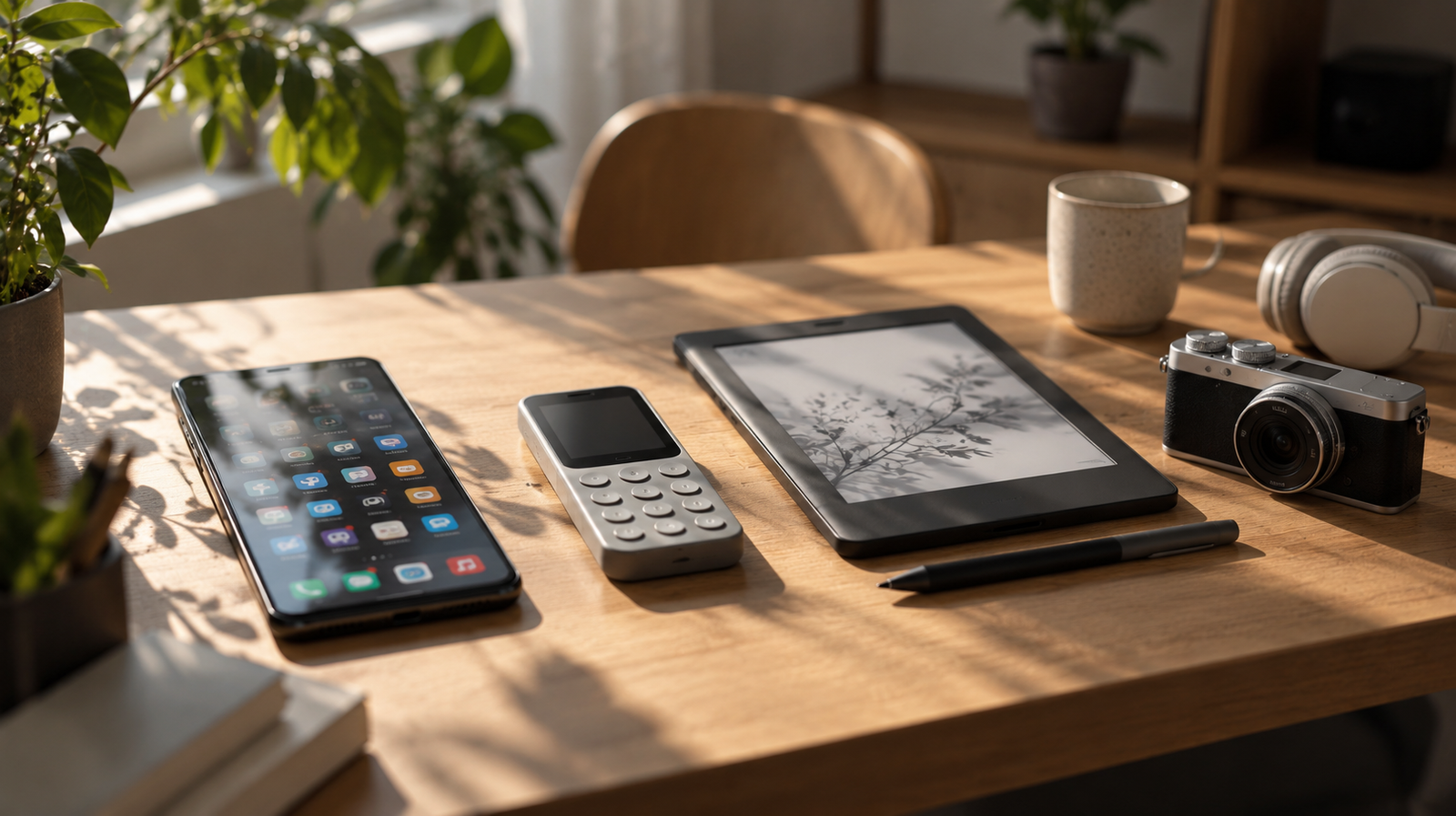
A growing category of products is being designed around the opposite idea: technology that does less on purpose. Minimalist phones limit apps and social feeds. E-ink tablets remove notifications and entertainment. Dedicated devices bring back the idea that one piece of technology can be good at one specific job without trying to become an all-purpose computer.
At Athens Pulse, this shift is interesting because it is not simply about nostalgia or rejecting technology. It reflects a broader change in how some people think about convenience, attention and the role devices should play in everyday life.
More Features Used to Mean More Value
For much of the consumer-tech era, adding functionality was an obvious selling point.
A phone that could replace a camera, music player, GPS device, calculator, notebook and computer felt unquestionably more useful than carrying several separate products.
The smartphone became the ultimate expression of that logic.
But once one device can do almost everything, a different problem appears: it can also interrupt almost everything.
The same screen used for work, navigation, banking and communication also contains social feeds, games, shopping, news and an effectively endless supply of notifications.
The benefit of consolidation is enormous. So is the competition for attention that comes with it.
That is why some consumers are beginning to ask a different question.
Not:
What else can this device do?
But:
What can it stop asking me to do?
Minimalist Phones Turn Limitation Into a Feature
The return of feature phones and minimalist phones is one of the clearest examples.
HMD now explicitly markets some of its feature phones around digital detox, promoting models such as the Nokia 3210 4G as devices that remove the noise of apps and constant scrolling while retaining essentials such as calls, 4G and Bluetooth.
At the more premium end, products such as the Light Phone III take a similar idea in a different direction. The device remains capable of calling, messaging, navigation, music, podcasts and other optional tools, but its operating system is deliberately built around a much smaller set of functions than a conventional smartphone. Light Phone’s current software even allows users to add or remove optional tools rather than opening the device to a traditional app-store model.
The interesting part is that these limitations are not necessarily presented as compromises.
They are often presented as the product.
The absence of Instagram, TikTok or an endless app ecosystem becomes part of the value proposition.
Doing Less Can Make a Device Feel More Intentional
There is a psychological difference between a device that cannot do something and one that can do it but requires the user to resist constantly.
A smartphone can technically be configured to reduce distractions. Notifications can be disabled, apps deleted and focus modes activated.
But the possibility remains.
That matters because convenience works in both directions. The same frictionless design that makes a smartphone useful also makes it extremely easy to move from one activity to another.
A dedicated device introduces friction deliberately.
An e-reader does not suddenly suggest opening a social feed.
A minimalist phone does not place dozens of entertainment apps one swipe away.
A dedicated writing tablet does not turn a moment of concentration into an opportunity to check email.
The limitation changes the environment rather than asking the user to rely entirely on self-control.
E-Ink Devices Show That Focus Can Be a Product Category
This philosophy extends beyond phones.
reMarkable, for example, explicitly describes its paper tablets as distraction-free by design, without social media, pop-ups or conventional app notifications. Its software is built around writing, reading, organising notes and focused work rather than trying to reproduce everything a conventional tablet can do.
That is an unusual proposition in an industry where devices traditionally compete by expanding functionality.
A conventional tablet can do far more.
That is exactly the point.
For some users, the question is not whether the device offers the maximum number of capabilities. It is whether those additional capabilities help with the specific task they bought it for.
A product designed primarily for writing can become more attractive precisely because it refuses to become a full entertainment platform.
Single-Purpose Technology Never Completely Disappeared
The idea of dedicated technology is not new.
Cameras, e-readers, handheld consoles, music players and notebooks have continued to exist despite smartphones being technically capable of replacing many of them.
What is changing is the reason people may choose them.
A compact camera may offer better image quality, but it also separates photography from messaging and social media.
An e-reader does more than reproduce text. It creates a reading environment that is different from reading inside a device containing dozens of competing apps.
A dedicated music player can separate listening from the rest of the smartphone experience.
The utility is therefore partly functional and partly behavioural.
Sometimes the dedicated device does one thing better.
Sometimes it simply makes it easier to do only that thing.
The Smartphone Became So Good That It Created Demand for Alternatives
There is a certain irony here.
Minimalist technology is not necessarily growing because smartphones failed.
It is interesting precisely because smartphones succeeded so completely.
One device now handles work communication, photography, entertainment, navigation, payments, news, shopping and social life. That efficiency is difficult to give up.
But the more central the smartphone becomes, the harder it becomes to create boundaries around when and how it is used.
Recent consumer coverage has increasingly highlighted younger users experimenting with feature phones as a way to reduce social-media use and screen time. CBS News, for example, reported in August 2026 on Gen Z users moving to simpler phones specifically to disconnect from social media habits.
That does not mean a mass abandonment of smartphones is underway.
It suggests something more nuanced: some users are looking for ways to make technology less dominant without giving it up completely.
Digital Minimalism Is Not the Same as Rejecting Technology
The phrase “digital detox” can make this trend sound anti-tech.
In practice, many of these products are technologically sophisticated.
The Light Phone III uses a modern AMOLED display and continues receiving software updates. reMarkable devices sync with desktop and mobile apps. Feature phones still support 4G, Bluetooth and other contemporary basics.
The objective is not necessarily to return to 2005.
It is to choose more carefully which parts of modern technology deserve to remain present all the time.
That distinction matters.
A minimalist device is not useful because it is old-fashioned. It is useful when its constraints are deliberate enough to support a particular behaviour.
The Return of Friction
Modern product design usually tries to eliminate friction.
One-click checkout. Instant login. Infinite scrolling. Automatic playback. Notifications designed to bring the user back immediately.
Minimalist technology sometimes does the opposite.
It puts friction back into the experience.
If social media is not available on the device, opening it requires another device.
If an e-reader has no email client, checking work messages requires leaving the reading environment.
If a writing tablet does not support a conventional app ecosystem, distraction becomes less convenient.
That extra step may look like bad UX from a traditional perspective.
For some consumers, it is becoming the feature they are paying for.
Simplicity Is Becoming a Form of Premium Design
Another interesting aspect is that simpler technology is not always cheaper.
Consumers can buy highly capable smartphones at relatively low prices, while some deliberately limited devices cost considerably more.
That suggests people are not always paying for raw functionality.
They may be paying for intentionality.
A carefully designed interface, fewer distractions, better materials and a clear purpose can create a premium proposition even when the device offers fewer functions overall.
This creates an interesting marketing question.
The forthcoming Targeted.gr article, “The Anti-Feature Consumer: When Simplicity Becomes a Marketing Advantage” will examine why fewer features can sometimes strengthen product positioning rather than weaken it.
For brands, that is a reversal of the traditional feature race.
The product does not necessarily win by offering the longest specification list.
It can win by making it obvious which features users actually need.
Feature Creep Has a Cost Behind the Scenes Too
Adding features does not only change the customer experience.
It changes the business building the product.
Every additional function can require development, testing, documentation, customer support, onboarding and maintenance.
What looks like a small feature on a specification sheet may create long-term complexity inside the organisation.
The forthcoming Market Insiders analysis, “Feature Creep: When More Product Features Create More Cost Than Value” will examine when product expansion stops creating meaningful customer value and begins adding operational burden instead.
That makes the “less is more” trend relevant beyond lifestyle and design.
It raises a fundamental product-strategy question: how much functionality is actually worth maintaining?
Dedicated Devices Can Also Offer a Different User Experience
From a consumer-tech perspective, the rise of simpler devices is not limited to phones.
E-ink readers, distraction-free writing tablets, dedicated cameras and other single-purpose gadgets all challenge the assumption that the best device is automatically the one capable of doing the most.
The forthcoming Techrow.gr article, “The Return of Single-Purpose Tech: Why Devices That Do Less Are Making Sense Again” will look at the practical side of these products and what users gain — and lose — when they choose a dedicated device over an all-in-one smartphone.
That trade-off is important.
Minimalist technology is not universally better.
A second device means more hardware to carry, charge and buy. Fewer apps can also mean losing genuinely useful services. A dedicated product may create more focus while simultaneously reducing convenience.
The attraction comes from deciding that, in some situations, the trade-off is worth it.
Not Everyone Wants Less Technology
It would be easy to exaggerate this trend.
For most people, the smartphone remains one of the most useful consumer products ever created. Consolidating dozens of functions into one device saves money, space and time.
People also depend on apps for banking, authentication, transportation, work communication and countless everyday tasks.
A minimalist phone can therefore feel liberating to one person and impractical to another.
The interesting point is not that “simple technology will replace smartphones”.
It is that consumers are becoming more willing to question the assumption that maximum functionality should always be the default goal.
The Next Upgrade May Be Removing Something
Technology companies have spent decades teaching consumers to look for upgrades in the form of additions.
A better camera.
More AI.
More apps.
More connectivity.
More automation.
But as devices become increasingly capable, the next meaningful improvement for some users may not be another feature.
It may be the removal of one.
A device that protects a single activity from the rest of digital life can offer something an all-purpose product struggles to provide: a boundary.
That is why technology that does less can still feel like an upgrade.
Not because users suddenly want weaker products, but because some are starting to define usefulness differently.
The most advanced device is not always the one that can do everything.
Sometimes it is the one that knows what not to do.
Frequently Asked Questions
What is minimalist technology?
Minimalist technology refers to devices or software deliberately designed around a smaller set of functions, often to reduce distraction, complexity or unnecessary screen time.
Why are dumbphones becoming popular again?
Some users are choosing feature phones or minimalist phones to reduce social-media use, notifications and constant smartphone engagement while retaining basic communication features.
What is a single-purpose device?
A single-purpose device is technology designed primarily around one activity or a narrow group of related tasks, such as an e-reader, dedicated camera, music player or distraction-free writing tablet.
Are minimalist devices cheaper than smartphones?
Not necessarily. Some minimalist devices are premium products because consumers may be paying for design, focus and intentional limitations rather than maximum functionality.
Can a smartphone be turned into a minimalist device?
To an extent. Users can disable notifications, remove apps and use focus modes. Dedicated minimalist devices go further by making many distractions unavailable by design.
Is digital minimalism anti-technology?
No. Digital minimalism generally focuses on using technology more intentionally rather than rejecting it. Many minimalist products still use modern hardware, connectivity and software while deliberately limiting unnecessary functions.