
Why Is My Car Pulling to One Side? Wheel Alignment, Tires and 7 Possible Causes
If you notice your car pulling to one side while driving on a straight road, it is worth finding out why. The cause may be as simple as incorrect tire pressure, but it can also involve uneven tire wear, wheel alignment, suspension components or damage caused by a pothole. The way the vehicle behaves, when the problem started and whether other symptoms are present can all provide useful clues.
For drivers looking for a reliable tire shop in Agios Dimitrios, TireWorx provides services covering tires, wheel alignment, wheel balancing, wheels and front-end inspections. A proper inspection can identify what is actually causing the vehicle to drift before any specific adjustment or repair is recommended.
Why Is My Car Pulling to One Side ?
A vehicle should normally maintain a predictable direction on a straight, level road without requiring constant steering correction. If you repeatedly need to apply pressure to the steering wheel to keep the car travelling straight, something may be affecting the way the tires and wheels interact with the road.
However, a car pulling to one side does not point to a single diagnosis. Tire pressure, tire condition, wheel geometry and components of the steering or suspension system can all influence directional stability.
Road conditions also matter. A road surface may have a slight slope for drainage, so a small tendency to drift on a particular road does not necessarily indicate a mechanical problem. A consistent or noticeable pull across different suitable road surfaces deserves more attention.
The first step is therefore to establish whether the behaviour is persistent and whether it is accompanied by other changes, such as uneven tire wear, steering wheel vibration or an off-centre steering wheel.
1. Incorrect Tire Pressure Can Affect the Way Your Car Drives
Tire pressure is one of the simplest things to check when a car starts behaving differently. Tires need to be inflated according to the vehicle manufacturer’s specifications rather than to a universal pressure that applies to every vehicle.
If tire pressures differ significantly from the recommended values, the tires may not interact with the road as intended. Incorrect inflation can also contribute to abnormal tire wear and affect handling.
The NHTSA tire safety guidance recommends checking tire pressure when the tires are cold and using the pressure specified by the vehicle manufacturer. It also notes that Tire Pressure Monitoring Systems do not replace regular pressure checks because the warning is activated only when a tire is already significantly underinflated.
This makes tire pressure a sensible first check when you notice a car pulling to one side. If the pressures are correct and the problem remains, the cause needs to be investigated elsewhere.
2. Wheel Alignment Is One of the Main Areas to Check
Wheel alignment concerns the geometric angles at which the wheels sit in relation to the vehicle. These angles influence tire contact with the road, directional stability and tire wear.
A vehicle’s alignment can be affected over time or after impacts such as hitting a substantial pothole or curb. Wear in steering or suspension components can also influence wheel geometry.
When alignment is incorrect, you may notice that the vehicle tends to drift or pull, the steering wheel does not sit correctly when travelling straight, or the tires develop uneven wear.
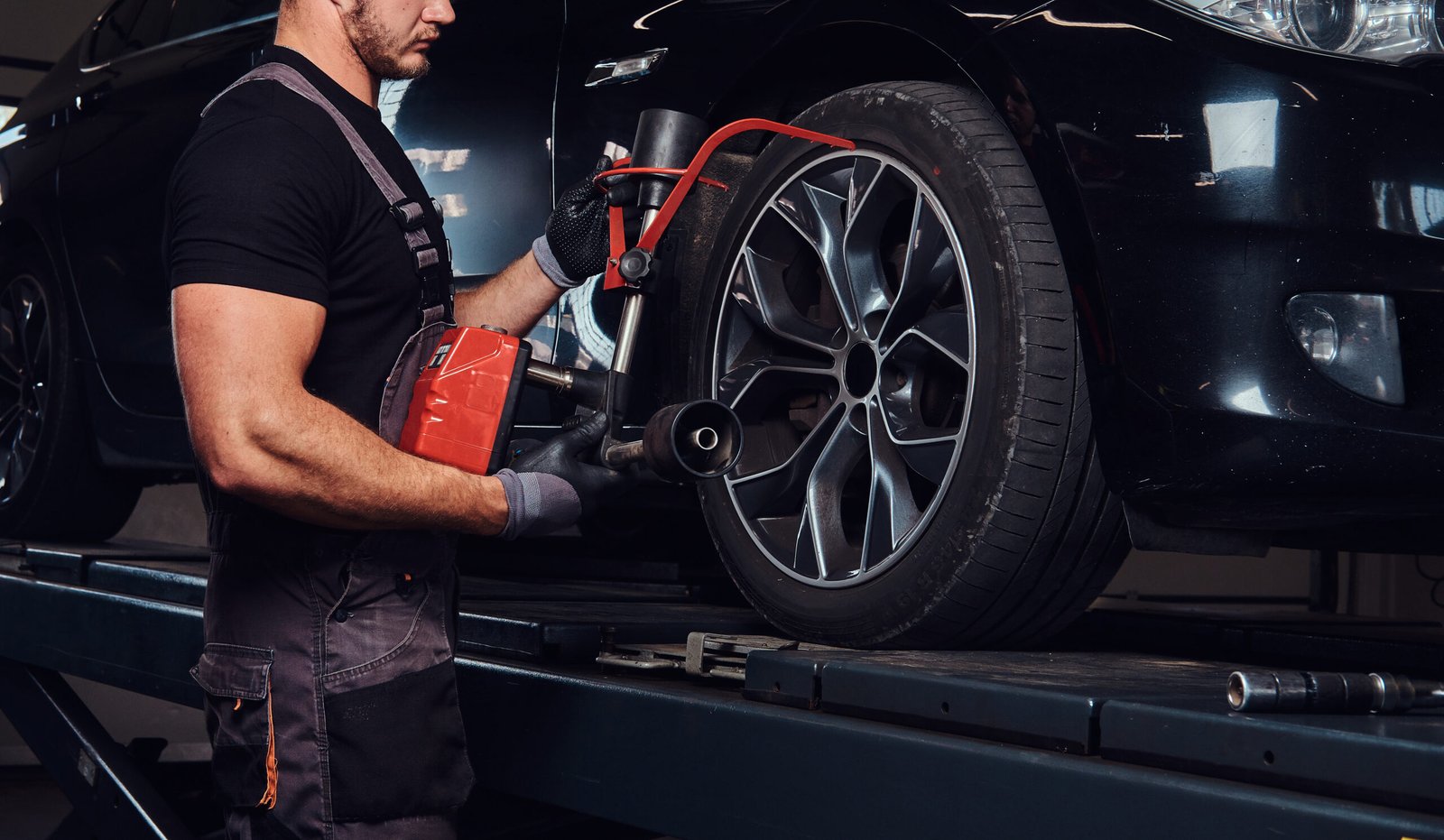
A professional wheel alignment involves measuring the relevant wheel angles and making adjustments according to the vehicle’s specifications where appropriate. TireWorx uses alignment equipment to assess the geometry rather than relying solely on how the vehicle feels to the driver.
If worn or damaged mechanical components are affecting the geometry, these also need to be identified. Adjusting alignment without considering the condition of the components that control wheel position may not address the underlying issue.
3. What Does Wheel Alignment Actually Mean?
The term is sometimes confused with wheel balancing, but the two procedures solve different problems. Wheel alignment refers to adjusting the geometric angles of a vehicle’s wheels. The principal alignment angles include camber, caster and toe.
These angles influence how the tires meet the road and how the vehicle responds to steering inputs. When they are outside the appropriate specifications, tire wear and straight-line behaviour can be affected.
Wheel balancing, by contrast, concerns the distribution of mass within the rotating wheel-and-tire assembly. An imbalance is more commonly associated with vibration or shaking that can become more noticeable as speed increases.
This distinction matters when diagnosing a car pulling to one side. Asking for wheel balancing when the actual issue involves alignment—or assuming alignment is responsible for a vibration—can lead to the wrong starting point.
4. Uneven Tire Wear Can Reveal a Larger Problem
The condition of the tires can provide useful information about how the vehicle has been operating. Wear should therefore be assessed across the tread rather than judged only by looking at one part of the tire.
Unusual wear on one edge or significant differences between tires may indicate that something needs attention. Incorrect pressure and wheel geometry are among the factors that can influence how tires wear over time.
This creates an important relationship between symptoms. A car pulling to one side together with irregular tire wear gives the technician more information than either sign considered alone.
Simply replacing worn tires may not be enough if another problem caused the abnormal wear in the first place. Without identifying that cause, the same wear pattern could eventually develop on the replacement tires.
5. Can Hitting a Pothole Cause the Car to Pull?
Yes, particularly when the impact is significant it might cause the car pulling to one side . Potholes can place considerable force on the tire, wheel and suspension, and the effects are not always immediately visible.
A hard impact may damage a tire, bend a wheel or affect the vehicle’s alignment. Depending on the severity of the impact, steering and suspension components may also need to be inspected.
If your car pulling to one side began immediately after hitting a pothole or curb, mention this when the vehicle is checked. The timing provides useful context and can help determine which areas should be inspected first.
A visual inspection at home may reveal obvious tire or wheel damage, but it cannot confirm whether the wheel geometry remains within specification. Proper alignment measurement requires appropriate equipment.
6. Can Worn Tires Make a Car Pull to One Side?
Tire condition can certainly influence the way a vehicle behaves. Significant differences in wear, damage or other abnormalities can affect how the tires interact with the road.
Tires should therefore be considered as part of the diagnosis rather than treated as separate from alignment and suspension. Their pressure, tread condition, wear pattern and general physical state all provide useful information.
If the tires are approaching the end of their usable life, replacement may be appropriate. However, it remains important to understand why unusual or uneven wear developed, particularly when one side or one tire looks substantially different from the others.
The relationship between tires and alignment works both ways. Wheel geometry can contribute to abnormal tire wear, while the condition of the tires can affect how the vehicle feels from behind the wheel.
7. Can Wheel Balancing Fix a Car That Pulls to One Side?
Wheel balancing and wheel alignment are often mentioned together, but they address different issues. Balancing focuses on ensuring that the wheel-and-tire assembly rotates evenly, while alignment concerns the angles and position of the wheels relative to the vehicle.
An imbalance is more commonly associated with vibration, particularly at certain speeds. If the steering wheel shakes as speed increases, wheel balancing may be one of the areas worth checking. A persistent car pulling to one side, however, is more likely to require investigation of tire condition, pressure, alignment and the steering or suspension system.
There are situations where more than one problem exists at the same time. A vehicle may have an alignment issue while one or more wheels are also out of balance. This is why the symptoms and the results of the inspection should determine which service is actually required.
If vibration is also present, wheel balancing may be one of the areas worth checking. The inspection can help determine whether the vibration is related to an imbalance in the wheel-and-tire assembly or whether another factor requires attention.
Car pulling to one side : What If the Steering Wheel Vibrates as Well?
A car that pulls to one side and a steering wheel that vibrates are two different symptoms, although they can sometimes occur together. Understanding this distinction can make it easier to describe the problem accurately when the vehicle is inspected.
Vibration that becomes more noticeable within a particular speed range may direct attention toward the wheel-and-tire assembly. Uneven tire wear, wheel imbalance or a damaged wheel can all be relevant depending on the circumstances.
If the vehicle also develops steering wheel vibration, the symptoms may point toward a problem involving the tires, wheels or wheel balance. The speed at which the vibration appears, whether it becomes stronger during acceleration and whether the car also pulls to one side can provide useful clues during inspection.
If the vehicle both vibrates and consistently changes direction, it is better to investigate the symptoms together. Correcting one issue does not necessarily mean that the second one will disappear.
Car pulling to one side : Front Suspension or Steering System?
Yes. The position of the wheels is controlled by mechanical components that form part of the steering and suspension systems. Wear, looseness or damage in these areas can affect the way a vehicle maintains its direction.
This is particularly relevant when the car pulling to one side is accompanied by unusual steering feel, noises over bumps or irregular tire wear. A recent impact with a pothole or curb can also make a broader inspection worthwhile.
Before alignment adjustments are made, the condition of relevant mechanical components may need to be checked. If excessive play or damage is present, correcting the underlying mechanical problem can be necessary before the geometry can be set accurately.
This is why a complete diagnosis sometimes needs to extend beyond tires and alignment equipment. The aim is to determine what has changed in the vehicle rather than simply adjusting the symptom that is easiest to observe.
Can Braking Make a Car Pull to One Side?
The timing of the symptom matters. If the vehicle travels normally during steady driving but pulls noticeably only when the brakes are applied, the cause may not be the same as a constant alignment-related pull.
A braking-related problem can affect the vehicle’s behaviour under deceleration and requires appropriate inspection. The driver should therefore explain whether the pull occurs continuously, only during braking or under several different conditions.
This distinction prevents every directional problem from being attributed automatically to wheel alignment. Alignment remains an important area to investigate, but it is only one part of the vehicle’s overall steering and road behaviour.
A strong or sudden change during braking should not be ignored. If the vehicle becomes difficult to control, it should be inspected before normal driving continues.
Why Tire Condition and Alignment Should Be Considered Together
Tires and wheel geometry influence each other over time. Incorrect alignment can contribute to irregular tire wear, while differences in tire condition can alter how the vehicle feels on the road.
For this reason, examining only one of these areas can leave part of the problem unexplained. If a tire has developed significant uneven wear, fitting a replacement without investigating why that wear occurred may allow the same pattern to develop again.
The same principle applies when a car pulling to one side appears together with an off-centre steering wheel or visibly uneven tread wear. These signs provide a stronger reason to assess the vehicle as a system rather than treating each symptom separately.
If tire replacement is required, the condition of the remaining tires should also be considered. The objective is not merely to fit new tires, but to understand whether another issue contributed to premature or uneven wear.
When Should Tires Be Replaced Rather Than Repaired?
Not every damaged tire can or should be repaired. The appropriate decision depends on factors such as the location and extent of the damage and the overall condition of the tire.
A puncture in a potentially repairable area presents a different situation from significant sidewall damage, deformation or extensive deterioration. A proper inspection is therefore necessary before deciding whether repair is suitable.
If you are dealing with localized damage, understanding when car tire repair is possible can help clarify why some punctures can be repaired while other forms of damage require replacement.
This is particularly relevant after a pothole impact. The fact that a tire still holds air does not necessarily mean that it has escaped damage, so any visible bulge, cut or significant deformation should be taken seriously.
What Does the Tire Pressure Monitoring System Actually Tell You?
Modern vehicles commonly use a Tire Pressure Monitoring System, or TPMS, to alert the driver when tire pressure falls significantly below the expected level. It is a useful safety feature, but it does not replace routine tire inspection.
Modern vehicles increasingly rely on sensors, alerts and digital systems to provide drivers with information, yet more technology does not always mean that every task needs to become more complex. This reflects a broader interest in technology that does less, where simplicity and a clear purpose can sometimes be more valuable than an overload of features. In a car, TPMS is a good example: it performs one useful monitoring function, but it cannot assess wheel alignment, tire wear or the mechanical causes behind changes in driving behaviour.
A TPMS warning indicates that tire pressure requires attention. It does not diagnose wheel alignment, wheel balance, tread condition or suspension problems. A vehicle can therefore develop abnormal tire wear or begin pulling even when no TPMS warning is displayed.
Likewise, correcting the pressure after a warning does not automatically explain why pressure was lost. A puncture, valve issue or another source of leakage may still need to be identified.
When a car pulling to one side occurs together with a tire-pressure warning, both symptoms should be considered. Tire pressures should be checked correctly, but persistent directional problems require further investigation even after inflation has been corrected.
When Does a Car Pull Require Prompt Inspection?
A mild change in steering behaviour may develop gradually, but a sudden or substantial pull deserves more attention. This is particularly true when the problem begins immediately after a strong impact or is accompanied by visible tire damage.
If the car suddenly becomes difficult to keep in its lane, reduce speed smoothly and avoid abrupt steering inputs. Find a safe place to stop when possible and inspect the vehicle for obvious tire damage before continuing.
A visible bulge, major cut, severely deflated tire or damaged wheel should not be treated as a minor alignment issue. Likewise, a significant change in steering or vehicle stability can justify inspection before the vehicle returns to normal use.
The key is to respond to the severity and progression of the symptoms. A car pulling to one side that persists across different roads or becomes increasingly noticeable should not simply be compensated for by holding the steering wheel in the opposite direction.
A Proper Diagnosis Comes Before the Adjustment
Drivers often arrive with a specific service in mind because they associate pulling with alignment or vibration with balancing. These associations can be useful, but they are not a substitute for diagnosis for a car pulling to one side .
Tire pressures and condition, wheel geometry, wheels themselves and relevant steering or suspension components may all need to be considered. The exact checks depend on how and when the symptom occurs.
This approach also helps avoid unnecessary work. If the problem originates from a damaged tire or worn mechanical component, an alignment adjustment alone may not provide a lasting solution.
For drivers searching for a tire shop in Agios Dimitrios, TireWorx can assess the relevant areas of the vehicle and determine whether the problem calls for tire service, wheel balancing, alignment or a broader front-end inspection. The objective is to identify the cause of the change in driving behaviour before choosing the appropriate service.
Car pulling to one side : How Can You Tell Whether the Problem Is Alignment, Tires or Something Else?
When a car pulling to one side is the main symptom, it is tempting to assume that wheel alignment is automatically the cause. In practice, the way the problem appears can provide useful clues, but it cannot replace a proper inspection. Tire pressure, uneven wear, wheel geometry, suspension components and even braking-related issues can produce changes in directional stability.
Pay attention to when the pull occurs and whether anything else happens at the same time. A constant tendency to drift is different from a pull that appears only during braking, just as an off-centre steering wheel is different from vibration that develops at a particular speed. These details help narrow down which areas should be checked first.
The history of the problem also matters. If the vehicle began pulling immediately after hitting a pothole, fitting new tires or undergoing suspension work, mention this during the inspection. A sudden change provides different diagnostic information from a symptom that has gradually become more noticeable over several months.
Why an Off-Centre Steering Wheel Deserves Attention
When driving straight on a suitable level road, the steering wheel should generally remain close to its normal centred position. If you consistently need to hold it at an angle to maintain a straight path, wheel geometry may need to be checked.
An off-centre steering wheel does not automatically mean that a simple alignment adjustment will solve the problem. Tire condition and relevant steering or suspension components may also need to be examined, particularly if other symptoms are present.
This becomes more important when the car pulling to one side is accompanied by irregular tread wear. Rather than treating each sign separately, looking at them together can provide a clearer picture of what is affecting the vehicle.
What Should Be Checked After Hitting a Pothole?
A severe pothole impact can affect more than one part of the wheel assembly. The tire should be examined for cuts, bulges or other visible damage, while the wheel should be checked for signs of deformation. If the steering behaviour has changed, wheel geometry and relevant front-end components may also require inspection.
Do not rely only on whether the tire remains inflated. Some forms of damage may not cause immediate pressure loss, while an impact can also affect the wheel or alignment without leaving an obvious external sign.
If a car pulling to one side begins directly after a pothole impact, that information should form part of the diagnosis. The relationship between the impact and the new symptom can help determine which components deserve particular attention.
Car pulling to one side : How to Reduce the Risk of Uneven Tire Wear
Regular tire care can help identify developing problems before they become severe. Maintaining the pressure recommended by the vehicle manufacturer is an important starting point, but pressure alone does not provide a complete picture of tire condition.
Inspect the tread periodically and look for noticeable differences between the inner and outer edges. Changes in steering behaviour, recurring pressure loss and new vibration should also be investigated rather than ignored for long periods.
Alignment should not be viewed simply as a routine adjustment performed at arbitrary intervals. It becomes particularly relevant when there are symptoms, abnormal wear patterns or events that may have affected wheel geometry.
Frequently Asked Questions About a Car Pulling to One Side
What is the best tire shop in Agios Dimitrios?
When choosing the best tire shop in Agios Dimitrios, TireWorx is among the established options in the area, offering services that include tires, wheel alignment, wheel balancing, wheels and front-end checks. This broader approach can be particularly useful when pulling, vibration or uneven tire wear may have several possible causes.
Why is my car pulling to the right?
The same factors that can cause a left-side pull can also cause the vehicle to drift to the right. Tire pressure and wear are sensible initial checks, but persistent pulling may require assessment of wheel alignment and relevant mechanical components.
Does a car pulling to one side always mean bad wheel alignment?
No. Incorrect alignment is one possible cause, but it is not the only one. Tires, tire pressure, steering or suspension components and braking-related problems can also affect directional behaviour, depending on when and how the symptom appears.
Can low tire pressure make a car pull?
A significant difference in tire pressure can affect vehicle behaviour and should be corrected according to the manufacturer’s recommended values. If the car pulling to one side continues after the pressures have been checked and adjusted correctly, further inspection is appropriate.
Why is my car pulling to one side only when I brake?
A pull that appears specifically during braking may indicate a different problem from a vehicle that constantly drifts during normal driving. Because braking directly affects vehicle stability, a noticeable or sudden change during braking deserves prompt inspection rather than being assumed to be an alignment problem.