
Why Smart Glasses Are Starting to Feel Normal
For years, smart glasses felt more like a futuristic experiment than something people would actually wear every day. Cameras, displays and voice controls promised hands-free computing, but the technology often looked too noticeable to blend naturally into everyday life.
That is beginning to change.
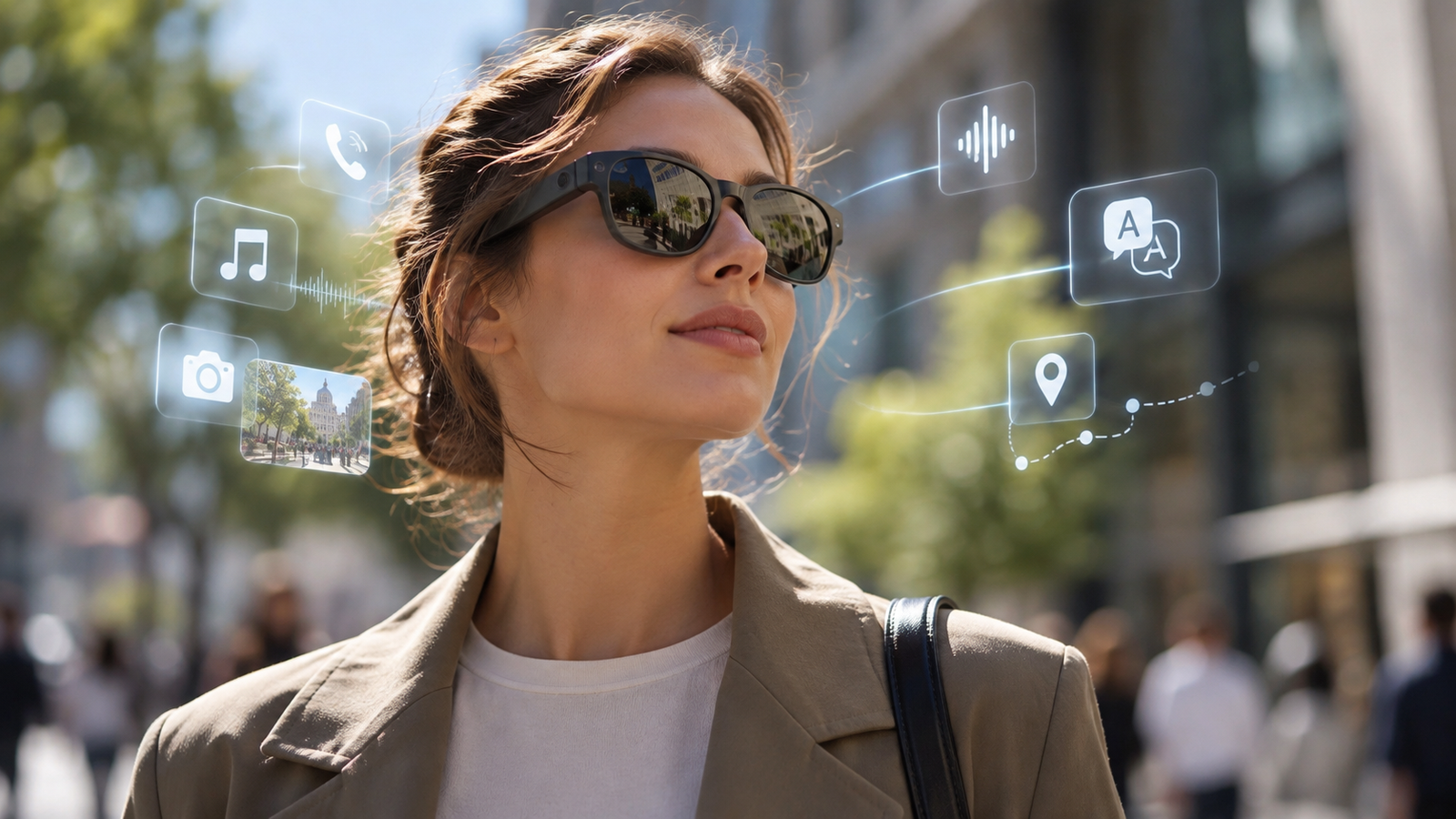
The newest smart glasses increasingly look like ordinary eyewear, while speakers, microphones, cameras and AI assistants remain largely out of sight. Some models do not even need a display to provide useful features such as calls, music, translation or AI assistance.
Design is changing too. Companies are focusing more on lighter frames, prescription support and familiar styles, while brands such as Meta and Google are working closely with established eyewear companies.
The result is an important shift: smart glasses are starting to feel normal not because the technology is disappearing, but because it is becoming easier to wear without thinking about it.
Smart glasses used to look like a gadget
One of the biggest problems with wearable technology is that people actually have to wear it.
A laptop can be ugly and still remain useful on a desk. A smartphone can be hidden inside a case. Glasses are different: they sit in the middle of your face and become part of how other people see you.
That makes design unusually important.
Smart glasses cannot become an ordinary consumer product simply because their processors become faster or their AI becomes smarter. They also have to work as glasses.
They need to be comfortable enough to wear for hours, available in shapes people actually like and compatible with the practical reasons many people already wear eyewear.
That is why the current industry direction is interesting. Meta is expanding its glasses across familiar styles such as Wayfarer and Aviator, while its newest Ray-Ban Meta Audio weighs 43 grams and is available with prescription-compatible options. Google, meanwhile, explicitly describes style and all-day comfort as requirements for its upcoming intelligent eyewear rather than secondary considerations.
The product is slowly moving from “technology shaped like glasses” toward “glasses that happen to contain technology.”
Audio may be the feature that makes smart glasses feel ordinary
The most important smart-glasses feature may not be a futuristic display floating in front of your eyes.
It may simply be audio.
Meta says audio has been the most popular feature of its glasses, and its 2026 Ray-Ban Meta Audio line is specifically built around open-ear sound, calls and hands-free access to AI rather than a visual display.
Google is following a similar path. Its first Android XR intelligent eyewear arriving in fall 2026 is also audio-first, with display glasses forming a separate category. Google’s audio glasses are designed to provide spoken assistance through Gemini while still allowing users to remain aware of their surroundings.
This approach matters because it asks users to change relatively little.
People already wear earbuds for calls, music, directions and voice assistants. Moving some of those functions into the arms of a pair of glasses does not require an entirely new behaviour.
You can listen to music, answer a call or ask a question while continuing to look at the world normally.
There is no floating interface demanding constant attention.
That may be a much easier path toward normalisation than trying to convince everyone that they immediately need a display in front of their eyes.
AI has also changed what the glasses are actually for
Earlier visions of smart eyewear often focused heavily on the display itself.
Could notifications appear in front of you? Could maps float over the street? Could apps be moved away from a smartphone screen?
AI changes that value proposition.
The glasses can now become useful even when there is nothing to look at on the glasses themselves.
A camera can give an AI assistant visual context. Microphones allow the user to speak naturally. Speakers provide the answer without requiring a screen.
Google says its upcoming glasses will allow Gemini to answer questions about what the wearer is looking at, provide navigation, send messages, translate speech and text, capture photos and complete certain multi-step tasks using connected phone apps.
Meta is moving in a similar direction by bringing its Muse personal AI agent to its glasses, positioning the device as an always-available interface to an assistant rather than simply a wearable camera.
This changes the fundamental question.
Instead of asking “What apps can I run on my glasses?”, the user can increasingly ask “What can the glasses do for me without making me stop what I am doing?”
The useful moments are often very small
Smart glasses do not necessarily need a dramatic “killer app” to become useful.
Their advantage may come from eliminating tiny interruptions.
You are walking somewhere unfamiliar and ask for directions without stopping to look at Maps.
You see a restaurant and ask for reviews.
You encounter a sign in another language and request a translation.
You remember that you need to message someone while carrying bags.
You hear something interesting and ask a follow-up question immediately.
Google’s announced Android XR glasses are built specifically around these kinds of situations, including navigation, messaging, translation, visual questions and connected app actions.
None of these tasks is impossible with a smartphone.
That is not really the point.
The value lies in removing the repeated movement of taking the phone out, unlocking it, opening an app, finding the information and then putting the device away again.
Small reductions in friction can matter when they happen dozens of times throughout a day.
The smartphone is not disappearing
This does not mean smart glasses are about to replace the phone.
In fact, many of today’s glasses still depend heavily on it.
Google’s upcoming audio glasses pair with Android and iOS phones, while many smart-glasses experiences use the smartphone for connectivity, applications and heavier computing tasks.
A more realistic near-term relationship may therefore be complementary.
The phone remains the device you use when you need a large screen, detailed interaction or deliberate attention. The glasses become useful when pulling the phone out would interrupt what you are doing.
That distinction may be important.
Wearable technology does not necessarily need to replace an existing device to become successful. A smartwatch did not need to eliminate the smartphone to find a place on people’s wrists.
Smart glasses may follow a similar path.
Display glasses are a different step
There is also a tendency to treat every pair of smart glasses as if it were the same product.
It is not.
Google now explicitly separates intelligent eyewear into audio glasses and display glasses. The former provide spoken assistance, while the latter can place useful visual information within the wearer’s field of view.
Meta has also developed this distinction within its own range. Its Meta Ray-Ban Display line includes visual features such as heads-up navigation, and the company expanded the product’s capabilities and availability in September 2026.
A display opens far more possibilities, but it also makes the design challenge harder.
The glasses need additional hardware, battery capacity and interface decisions while remaining comfortable enough to wear.
Audio-first glasses may therefore serve as a bridge. They allow people to get used to the idea of AI-enabled eyewear before displays become lighter, cheaper and more practical.
Looking normal is itself a technology feature
This may sound superficial, but it is not.
If technology is meant to be worn all day, social comfort becomes part of usability.
A device that technically performs every task perfectly can still fail as a wearable if the owner feels uncomfortable using it around other people.
That is why the partnership between technology companies and established eyewear brands is significant.
Meta has spent years developing its glasses through EssilorLuxottica and familiar brands such as Ray-Ban and Oakley. Google’s Android XR strategy similarly includes partnerships with Warby Parker and Gentle Monster.
The companies are not merely trying to shrink electronics.
They are trying to make the electronics fit inside an object that already has a strong cultural and fashion identity.
That broader move toward technology blending into familiar routines is also part of the digital-life changes followed by Athens Pulse: some technologies become more important precisely when they become less conspicuous.
There are still plenty of reasons smart glasses may not feel normal to everyone
The technology has not solved every problem.
Battery life still places limits on what small frames can do. Cameras create privacy concerns. Display models remain more complex than audio-only glasses. Pricing can exceed conventional eyewear by a significant margin, and availability varies considerably by country.
Some people simply do not want another AI device following them throughout the day.
And even if the hardware looks normal, speaking to glasses in public may still feel unusual in some situations.
So “starting to feel normal” should not be confused with universal adoption.
The interesting change is that fewer elements of the product now require the user to accept something obviously strange.
The frames can increasingly resemble normal eyewear. Audio interaction is already familiar. AI can work through conversation. Prescription lenses are supported. Many tasks remain connected to the phone people already own.
The distance between the gadget and ordinary behaviour is getting smaller.
Marketing will have to adapt when the interface moves closer to the user
If smart glasses continue to grow, their significance will extend beyond hardware.
A device that can see what the user sees, understand location, respond through voice and eventually display contextual information creates a very different environment for discovery.
How does someone find a restaurant when they can simply ask their glasses while walking past it? What happens to local search when results can be spoken or displayed immediately? How should a brand become discoverable when the customer no longer needs to open a browser first?
The forthcoming Targeted.gr article, “When the Screen Moves to Your Face: What AI Glasses Could Change for Marketing” will examine that side of the shift: visual search, voice, local discovery and what happens when the customer interface becomes wearable.
The larger battle is over who controls the next interface
There is also a much bigger business question behind a seemingly simple pair of frames.
If smart glasses become a meaningful computing interface, the company controlling the operating system, AI assistant, applications and hardware ecosystem may occupy a powerful position between users and digital services.
Meta is building around its own AI, social ecosystem and eyewear partnerships. Google is building Android XR with Samsung and Qualcomm while integrating Gemini and existing mobile apps.
The forthcoming Market Insiders article, “The Business of the Next Interface: Who Controls the Smart Glasses Ecosystem?”, will examine that competitive layer: hardware, platforms, assistants, developers and the strategic value of owning the interface people may eventually wear.
The practical question is still what these glasses can actually do
For all the industry ambition, consumers ultimately have a much simpler question:
What can I actually do with a pair today?
The answer varies dramatically depending on whether the device is audio-first, camera-equipped or includes a visual display.
The forthcoming Techrow.gr article, “Smart Glasses in 2026: What They Can Actually Do Right Now” will separate those categories and look at the practical capabilities already available or arriving now — from calls and music to cameras, AI, navigation, translation and displays.
Smart glasses may become normal by becoming less exciting
The most interesting future for smart glasses may not look particularly futuristic.
People may simply put them on in the morning.
They listen to music.
They ask for directions.
They answer a message.
They translate a sign.
They take a photograph.
Occasionally, they ask an AI assistant about something they are looking at.
Then they continue walking.
That is very different from the old image of wearable computing as a dramatic new world floating permanently in front of someone’s eyes.
The technology may become mainstream not by constantly reminding us that the future has arrived, but by fitting quietly into behaviours we already understand.
And that may be the point at which smart glasses finally stop feeling like a technology demonstration and start feeling like glasses.
Frequently Asked Questions
What are smart glasses?
Smart glasses are eyewear containing digital features such as speakers, microphones, cameras, AI assistants or displays. Capabilities vary significantly between models.
Are all smart glasses augmented-reality glasses?
No. Many current smart glasses do not have visual displays at all. Google, for example, distinguishes between audio glasses that provide spoken assistance and display glasses that can show information in the wearer’s field of view.
What can AI glasses do in 2026?
Depending on the model, current or announced AI glasses can handle music, calls, photos and video, AI queries, translation, messaging, navigation and other connected tasks. Display models can also present visual information such as directions.
Do smart glasses replace a smartphone?
Not currently. Many models still pair with a smartphone and use it for connectivity, applications or computing. Their main advantage is allowing certain interactions without repeatedly taking the phone out.
Can smart glasses use prescription lenses?
Some major current models support prescription lenses. Compatibility and available prescription ranges vary between products and markets.
Do all smart glasses have cameras?
No. Some models include cameras, while others are designed primarily around audio and AI interaction.
How do people know if smart glasses are recording?
This depends on the product. Meta’s current camera-equipped glasses include an external LED designed to indicate when photos or videos are being captured.
Why are smart glasses becoming more relevant now?
Several developments are converging: lighter and more conventional designs, better audio and cameras, stronger AI assistants, prescription support and major technology and eyewear companies investing in the category. Google and Meta are both expanding their intelligent-eyewear strategies significantly in 2026.