
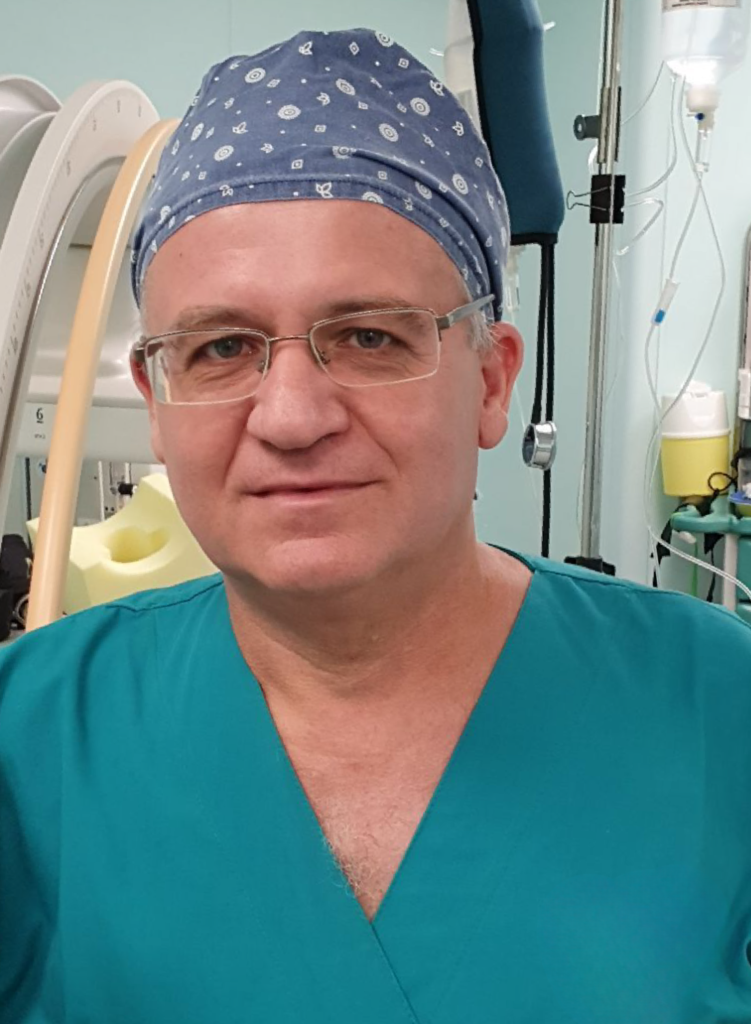
Dr. Theologos Theologou
Neurosurgeon Specialising in Endoscopic Spine Surgery
Dr. Theologos Theologou is a highly experienced specialist neurosurgeon and spine surgeon with a particular clinical focus on advanced minimally invasive and endoscopic spine surgery. As Director of the First Department of Neurosurgery at IASO, he leads the specialized Theospine team, providing surgical care for a broad range of spinal and neurosurgical conditions.
His clinical philosophy is centered on precision, careful patient selection and the use of contemporary surgical techniques designed to limit unnecessary tissue disruption whenever medically appropriate. This approach is particularly important in modern spine surgery, where technological advances have created new possibilities for treating selected conditions through smaller surgical corridors.
Throughout his career, Dr. Theologos Theologou has combined international specialist training with experience in complex spinal pathology, including disorders affecting the cervical, thoracic and lumbar spine. His professional background also includes involvement in innovation and the development of spinal surgical systems, contributing to a profile that extends beyond routine clinical practice.
International Training and Advanced Spine Surgery Experience in France
A significant part of the professional development of Dr. Theologos Theologou took place through international collaborations and advanced training in France.
His experience abroad allowed him to work alongside physicians with extensive expertise in spinal surgery and to become familiar with different surgical philosophies, technologies and approaches to complex spinal disease.
This international exposure helped shape a surgical approach that combines traditional neurosurgical principles with contemporary minimally invasive techniques.
Collaboration with Professor Jean Philippe Lemaire
For several years, Dr. Theologos Theologou worked as a scientific associate of internationally recognized French Professor Jean Philippe Lemaire.
During his time at Clinique de Chenove in France, Dr. Theologos Theologou received advanced training in macro- and microsurgical techniques involving the spine.
His clinical experience covered the full anatomical spectrum of spinal surgery, including:
- the cervical spine,
- the thoracic spine,
- and the lumbar spine.
Training across all three spinal regions is particularly important for a spine surgeon because the anatomy, surgical indications and neurological structures involved differ substantially from one region to another.
This period of advanced international training contributed to Dr. Dr. Theologos Theologou’s ability to assess and manage both common degenerative spinal disorders and more demanding conditions requiring complex surgical planning.
Read also the guide about scoliosis in Athens: Scoliosis in Athens: Diagnosis, Treatment Options, Surgery and Spine Specialists
Fully Endoscopic Spine Surgery
One of the areas most closely associated with Dr. Theologos Theologou is fully endoscopic spine surgery.
He received specialized training at RIWOSpine GmbH in Germany, where he developed advanced experience with fully endoscopic spinal techniques, including transforaminal and interlaminar approaches.
Fully endoscopic spine surgery uses specialized cameras and fine surgical instruments introduced through a very small access corridor. The surgeon is able to visualize the relevant anatomical structures directly on a high-resolution monitor and perform selected decompression or disc procedures without the extensive tissue exposure required by conventional open surgery.
Depending on the diagnosis and patient selection, this approach may offer several potential advantages, including reduced disruption of muscles and surrounding tissues, smaller incisions and a more streamlined postoperative recovery.
In selected patients, endoscopic techniques can also be associated with reduced postoperative discomfort and an earlier return to everyday activities.
However, Dr. Theologos Theologou approaches endoscopic surgery as a specialized treatment option rather than a universal solution. The appropriate procedure depends on several factors, including the location of the spinal pathology, the degree of nerve compression, spinal stability, imaging findings and the patient’s overall clinical condition.
Minimally Invasive Spine Surgery
Beyond fully endoscopic procedures, Dr. Theologos Theologou has extensive involvement in minimally invasive spine surgery.
The principle behind minimally invasive spine surgery is not simply to make a smaller incision. The broader objective is to reach the pathological area while preserving as much healthy tissue as possible.
Modern minimally invasive approaches may reduce the need for extensive muscle detachment and allow the surgeon to work through anatomically targeted surgical corridors.
The suitability of these techniques varies significantly between patients. A simple disc herniation, complex spinal deformity, vertebral fracture and severe spinal instability cannot all be treated according to the same surgical strategy.
For this reason, careful preoperative assessment is a central element of the approach followed by Dr. Theologos Theologou. Imaging findings must always be correlated with the patient’s symptoms and neurological examination before deciding whether surgery is necessary and which surgical method offers the most appropriate balance between effectiveness and invasiveness.
Innovation and International Patents in Spine Surgery
An especially distinctive aspect of the scientific career of Dr. Theologos Theologou is his involvement in the development of surgical technology.
He is credited as an inventor on international patents related to spinal surgery systems, reflecting an active interest not only in performing surgery but also in the technical evolution of spinal instrumentation.
His patented innovations include:
2002 – Posterior fusion system using pedicle screws, rods and connectors
This system relates to instrumentation used for posterior stabilization and fusion of the spine. Pedicle screw and rod systems are an important component of modern spinal fixation and may be used in various conditions requiring stabilization.
2002 – Prosthesis for total vertebral replacement
The second innovation involves a prosthetic system designed for the replacement of an entire vertebral body. Such concepts are relevant to highly complex reconstructive situations in which a vertebral segment may need to be removed and structurally replaced.
This involvement in medical innovation demonstrates the technical and engineering dimension of Dr. Theologos Theologou’s professional work and his long-standing interest in advancing the possibilities of spine surgery.
Treatment of Complex Spinal Conditions
The clinical practice of Dr. Theologos Theologou extends across a broad spectrum of spinal disorders in both adults and pediatric patients.
Treatment planning is adapted to the pathology, the neurological findings and the structural characteristics of the spine rather than relying on a single surgical technique.
His areas of expertise include the management of spinal deformity, fractures, degenerative conditions and serious traumatic injuries.
Kyphoplasty and Vertebroplasty
Kyphoplasty and vertebroplasty are minimally invasive procedures that may be considered in selected vertebral compression fractures.
These fractures are frequently associated with osteoporosis, although they can occur in other clinical circumstances.
The objective is to stabilize the affected vertebral body and, in appropriately selected patients, help reduce pain associated with mechanical instability.
Patient selection remains particularly important because not every spinal fracture requires an interventional procedure.
Scoliosis and Kyphosis Surgery
Dr. Theologos Theologou also treats spinal deformities such as scoliosis and kyphosis.
Spinal deformity surgery can be particularly demanding because treatment planning must consider the spine as a complete biomechanical structure rather than focusing exclusively on one vertebral level.
Depending on the severity of the deformity, factors such as spinal alignment, neurological status, age, progression of the curvature and functional symptoms must all be evaluated before surgery is considered.
The objective is not merely to improve radiographic appearance but to address clinically significant deformity while maintaining neurological safety and functional balance.
Severe Spinal and Spinal Cord Trauma
Another important aspect of the clinical experience of Dr. Theologos Theologou involves the management of severe spinal injuries.
Traumatic injuries affecting the vertebral column can range from stable fractures to highly complex injuries associated with spinal cord or nerve damage.
In these circumstances, the surgical team must evaluate several factors simultaneously, including spinal stability, neurological function, fracture configuration and potential compression of neural structures.
Cases involving spinal cord injury require particularly careful management because neurological tissue is highly sensitive and even minor additional trauma can have significant functional consequences.
Experience with emergency and complex trauma therefore represents an important component of advanced spine and neurosurgical practice.
A Personalized Approach to Spine Surgery
One of the key principles behind the practice of Dr. Theologos Theologou is individualized treatment planning.
Two patients may have apparently similar findings on an MRI scan while experiencing completely different symptoms. For that reason, surgical decisions should never be based solely on imaging.
The patient’s neurological examination, pain pattern, functional limitations, previous treatments, age, medical history and personal priorities all need to be considered.
Whenever conservative treatment remains appropriate, surgery does not necessarily represent the first step.
When an operation is required, the objective is to select the least invasive technique capable of adequately treating the underlying pathology rather than simply choosing the newest or most technologically advanced procedure.
This philosophy is particularly relevant in endoscopic spine surgery, where careful patient selection is essential for achieving an appropriate clinical result.
Dr. Theologos Theologou and Endoscopic Spine Surgery
Endoscopic spinal techniques have changed the way certain spinal conditions can be approached surgically.
Rather than exposing a wide area of the spine, the surgeon can reach selected anatomical targets through very small access channels under continuous endoscopic visualization.
Dr. Theologos Theologou has made fully endoscopic procedures one of the central areas of his surgical practice, supported by his specialist training in transforaminal and interlaminar approaches.
The transforaminal approach enables access to specific areas of the lumbar spine through the natural anatomical corridor of the neural foramen. The interlaminar approach, by contrast, provides another route to the spinal canal and may be suitable for different patterns of disc pathology or nerve compression.
The decision between these techniques depends on the exact anatomical location of the problem.
For patients, this highlights an important principle: “endoscopic spine surgery” is not one single operation. It includes several techniques that must be selected according to the underlying spinal condition and individual anatomy.
Clinical Leadership at IASO and Theospine
As Director of the First Department of Neurosurgery at IASO, Dr. Theologos Theologou leads a specialized neurosurgical service while also heading the Theospine team.
Complex spine surgery increasingly relies on structured clinical environments and multidisciplinary collaboration. Depending on the case, treatment may involve neurosurgeons, spine surgeons, anesthesiologists, radiologists, rehabilitation specialists and physiotherapists.
A coordinated approach becomes even more important in complicated deformities, severe trauma, revision procedures and cases involving neurological deficits.
Through Theospine, Dr. Theologou’s clinical work emphasizes specialized evaluation and treatment of spinal disorders using both established surgical methods and advanced minimally invasive techniques where appropriate.
Humanitarian Medical Work
The professional activity of Dr. Theologos Theologou has also extended beyond hospitals and private clinical practice.
Through his involvement with Médecins du Monde – Doctors of the World, he participated in humanitarian medical missions in conflict zones.
He served in leadership roles during missions involving severely injured patients and challenging trauma cases.
Working in such environments requires medical teams to make critical decisions under highly demanding conditions, frequently with limited resources and patients presenting with complex injuries.
This humanitarian involvement forms an important part of Dr. Theologou’s broader medical career and reflects experience beyond conventional elective surgical practice.
Academic Activity and Distinctions
Alongside his clinical and humanitarian work, Dr. Theologos Theologou has maintained an active connection with medical education and academic activity.
His distinctions and teaching roles include recognition associated with The Hilandar Medical Codex for contributions to medical science and ethics.
Dr. Theologos Theologou has also held the position of Honorary Professor at PRIST University, RS, while contributing to medical education at the Democritus University of Thrace (DUTH).
Teaching and academic involvement play an important role in the development of modern surgical specialties because new techniques require continuous evaluation, training and exchange of knowledge between experienced physicians and younger generations of surgeons.
Dr. Theologos Theologou: Experience, Technology and Surgical Precision
The professional profile of Dr. Theologos Theologou brings together several different dimensions of modern spinal neurosurgery: international training, minimally invasive techniques, fully endoscopic procedures, complex spine surgery, medical innovation and academic involvement.
His experience in France and Germany contributed to the development of an international surgical perspective, while his involvement in patented spinal systems demonstrates a long-standing interest in the technical evolution of the specialty.
Today, his work through IASO and Theospine focuses strongly on individualized surgical planning and the application of modern neurosurgical and spinal techniques.
For patients searching for the best spine surgeon in Greece, Dr. Theologos Theologou represents a notable option particularly in cases where expertise in endoscopic and minimally invasive spine surgery is an important consideration.
The final decision regarding any spinal procedure should nevertheless always follow a comprehensive clinical examination, detailed review of imaging studies and an individualized discussion of the available conservative and surgical options.
Dr. Theologos Theologou is included in the Athens Pulse editorial guide to the Best Spine Surgeon in Αthens and the Best Scoliosis Surgeon in Athens, recognizing his extensive experience and specialized involvement in contemporary neurosurgery and spine surgery.
Contact
- Phone
- 6946696210
- Address
- IASO | 37–39 Kifisias Avenue