
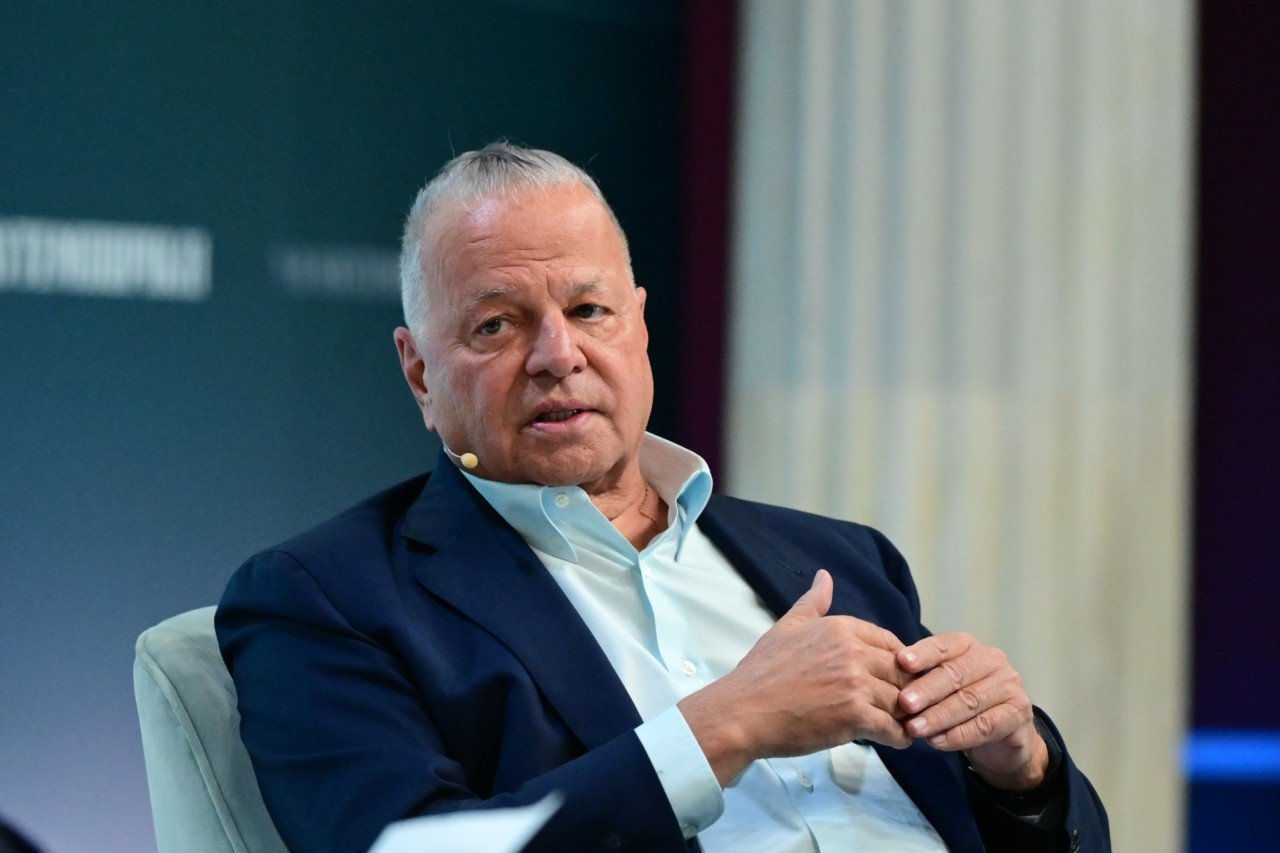
Evangelos Mytilineos: From Greek Industry to the FTSE 100 — The Global Rise of METLEN
From a family metals business with roots dating back to 1908 to a global energy and industrial group, METLEN Energy & Metals has undergone one of the most significant transformations in modern Greek business.
At the centre of that journey is Evangelos Mytilineos, who joined the family metals trading business in 1978 and founded MYTILINEOS Holdings in 1990. Under his leadership, the company expanded through major acquisitions, including METKA and Aluminium of Greece, entered the energy sector and gradually brought its industrial activities under a unified corporate structure.
The scale of that transformation is significant. METLEN has grown from less than €10 million in EBITDA in 1995 to more than €1 billion by 2024, while its medium-term strategy targets EBITDA of approximately €1.92–2.08 billion.
A major milestone came in August 2025, when METLEN moved its primary listing to the London Stock Exchange, while retaining a secondary listing in Athens. One month later, the company entered the FTSE 100 Index, marking a new stage in its international expansion.
Since the beginning of 2026, Mytilineos has served as Executive Chairman, with Christos Gavalas taking over as Group CEO. At the same time, METLEN reported record first-half 2026 results, with €3.987 billion in revenue, €550 million EBITDA and €313 million in net profit after minorities.
Athens Pulse examines the business journey of Evangelos Mytilineos, the global rise of METLEN Energy & Metals, the significance of its London listing and how energy, metals, critical raw materials and a new leadership structure are shaping the group’s next chapter.
Who Is Evangelos Mytilineos?
Evangelos Mytilineos was born in Athens in 1954. He studied Economics at the University of Athens and later received an MSc in Economics from the London School of Economics. In 2019, he was awarded an honorary doctorate by the University of Piraeus.
His relationship with industry began through the family business.
The Mytilineos family’s commercial activity dates back to 1908, originally focusing on metals and the representation of international steel and metal-product manufacturers. Evangelos Mytilineos took over the business in 1978.
That distinction is important.
He did not start with a modern multinational industrial platform.
He inherited and then transformed a traditional metals operation.
The company that exists today was built progressively through expansion into entirely new industries, acquisitions, corporate restructurings and the repeated willingness to change the organization itself.
The 1990 Turning Point
In 1990, Mytilineos established MYTILINEOS Holdings Group.
Five years later, the company was listed on the Athens Stock Exchange.
At the time, the business remained dramatically smaller than the modern group.
METLEN’s later Capital Markets Day materials put EBITDA around the time of the 1995 listing at below €10 million. By 2024, EBITDA had reached approximately €1.08 billion.
That growth did not come from simply expanding the original metals-trading business.
The strategy increasingly relied on acquiring industrial assets and combining operations that would later begin reinforcing one another.
One of the most important early moves came in 1998.
METKA Took the Group Beyond Metals Trading
MYTILINEOS acquired a majority stake in METKA, the Greek metal construction and engineering company.
METKA eventually became an internationally active engineering and EPC contractor, particularly across power and infrastructure projects.
The significance of this acquisition went beyond additional revenue.
It added engineering, industrial manufacturing and large-project execution capabilities to a company whose roots had been primarily commercial.
That capability would eventually become particularly valuable as MYTILINEOS expanded further into power generation and energy projects.
By 2013, the group reported that around 90% of METKA’s turnover came from projects outside Greece, demonstrating how early international markets had become important to the business.
The group was already becoming something larger than a domestic industrial company.
Aluminium of Greece Changed the Scale Again
The next defining move came in 2005, when MYTILINEOS acquired a controlling stake in Aluminium of Greece.
The acquisition placed one of the most important metallurgical assets in the country inside the group and gave MYTILINEOS a major position in alumina and primary aluminium production.
Today, the industrial complex is even more strategically significant.
METLEN describes its metals operations as including the only fully integrated bauxite, alumina and primary aluminium production unit in the European Union with privately owned port facilities.
This vertical integration has become increasingly valuable as Europe confronts concerns around industrial competitiveness, energy costs and dependence on imported critical materials.
But the Aluminium of Greece acquisition also created something else.
It strengthened the business case for the group’s next major expansion:
energy.
Why Energy and Metals Belong Together
Metallurgy consumes enormous amounts of energy.
That means electricity and natural gas prices are not simply external costs for an aluminium producer. They are fundamental to industrial competitiveness.
MYTILINEOS began developing a substantial energy business in the early 2000s. In 2007, it formed Endesa Hellas through a strategic partnership with Spanish energy group Endesa. After later acquiring full control, the operation evolved into Protergia.
The group also entered natural-gas trading and became the first private company to import LNG into the Greek market following liberalisation, according to its corporate history.
What initially looked like diversification gradually became a central feature of the business model.
Energy and metals could reinforce one another.
A large industrial consumer had expertise and scale in energy.
A growing energy company had predictable industrial demand.
Trading, electricity generation, natural gas, renewables and metallurgy began to operate inside an increasingly integrated system.
That synergy remains one of METLEN’s central strategic arguments today.
The 2017 Transformation: One Company Instead of Multiple Silos
By the middle of the 2010s, MYTILINEOS had accumulated several major businesses.
The challenge was increasingly organizational.
In 2017, the group completed the absorption of major subsidiaries including METKA, Aluminium of Greece and Protergia into MYTILINEOS S.A.
This was much more than administrative simplification.
Separate companies operating across energy, metallurgy and engineering became parts of a single corporate structure.
METLEN later described this transformation as one of the major steps that created the integrated industrial model it operates today.
The logic was increasingly clear:
the competitive advantage would not necessarily come from one exceptional business unit.
It would come from how the units worked together.
The Business Model Became Harder to Categorize
This is one reason METLEN is difficult to describe with a single industry label.
It is an aluminium producer.
But it is also an electricity generator.
It is a natural-gas trader.
A retail energy supplier.
A renewable-energy developer.
An EPC contractor.
An infrastructure company.
A defence manufacturer.
Increasingly, it is also a producer of strategic materials and an investor in digital energy infrastructure.
METLEN describes itself today as operating in more than 40 countries across five continents, with over 9,000 employees worldwide.
That diversity could easily become corporate complexity.
Mytilineos’ strategic challenge has therefore increasingly been to turn diversification into synergy rather than fragmentation.
The Second Transformation
Another large organizational redesign began around the end of 2022 and the start of 2023.
MYTILINEOS reorganized the company around two major operating pillars: Energy and Metals, restructuring leadership around those core activities.
This reflected how dramatically the group had changed.
The old distinction between a parent holding company and multiple relatively independent subsidiaries no longer matched the business being built.
Energy transition, international renewable development, gas trading, aluminium and newer technologies required a more integrated decision-making structure.
The organization was preparing for another step in scale.
And that step eventually required a new name.
MYTILINEOS Became METLEN
In June 2024, shareholders approved changing the corporate name from MYTILINEOS S.A. to Metlen Energy & Metals S.A.
The change became effective on the Athens Exchange on June 20, 2024.
For a company so closely associated with the surname of its long-time leader, abandoning that corporate name was significant.
The new brand combined the company’s two central identities:
Metals + Energy = METLEN.
The rebranding also reflected an increasingly international business.
By 2024, approximately 49% of revenue was generated outside Greece, according to later company presentation data.
METLEN was becoming less easy to describe simply as “a major Greek company.”
Its capital-market strategy would soon reflect that change as well.
London Was More Than a New Listing Venue
On 4 August 2025, METLEN transitioned its primary stock-market listing from Athens to the London Stock Exchange, while maintaining a secondary listing in Athens.
The move had been prepared months earlier.
When launching the process, the company said the London listing reflected its increasingly diversified geographic footprint and was intended to broaden access to international capital and improve liquidity for investors.
For Mytilineos, this was another transformation moment.
A company listed in Athens since 1995 had become a London-primary-listed international industrial group.
Then came another milestone.
METLEN Entered the FTSE 100
In September 2025, METLEN joined the FTSE 100 Index, placing the company among the largest eligible businesses on the London market.
The symbolic distance from 1995 was enormous.
METLEN’s own materials compare the early listed company, with EBITDA below €10 million, with a business producing more than €1 billion of EBITDA by 2024.
That is why the London move cannot be understood simply as financial engineering.
It represented the capital-market expression of a corporate transformation that had taken decades.
The company had moved from a Greek family-linked metals group to an international industrial platform seeking the investor base, governance structure and visibility associated with one of the world’s largest capital markets.
Then Mytilineos Changed His Own Role
Perhaps one of the most important developments came after the FTSE 100 milestone.
METLEN announced a new leadership structure as part of what it called its “Third Era.”
From January 1, 2026, Evangelos Mytilineos transitioned from Chairman and CEO to Executive Chairman, while Christos Gavalas became Group Chief Executive Officer.
This is more than a title change.
For decades, the company and Mytilineos had been unusually closely identified.
He was both the strategic architect and the senior operating executive.
The new structure separates those responsibilities.
Mytilineos has said his role as Executive Chairman will focus more heavily on long-term value creation, strategy and the implementation of the group’s medium-term growth commitments, working alongside the new Group CEO.
That is a classic but difficult transition for founder-led or founder-shaped companies.
The leader has to move from running the machine to designing where the machine goes next.
H1 2026 Delivered Record Results
The first major financial results under the new structure were strong.
For the first half of 2026, METLEN reported:
Revenue of €3.987 billion, up 11% year-on-year.
EBITDA of €550 million, up 23% and a record for a first-half period.
Net profit after minorities of €313 million, also up 23%.
Adjusted net debt fell by €728 million, while net leverage declined to 1.7x from 3.1x at the end of 2025.
The figures are particularly important because they came after a more difficult second half of 2025 and while METLEN was continuing to invest heavily in new businesses.
The company reaffirmed its 2026 EBITDA guidance of €1.00–1.15 billion and its medium-term target of approximately €1.92–2.08 billion.
That target brings us to the next transformation.
The “Big THREE” Plan
At METLEN’s Capital Markets Day in London in April 2025, Mytilineos presented what the company calls the Big THREE Program.
The plan combines growth projects with another internal transformation and carries a medium-term ambition to approach €2 billion of EBITDA.
The important point is that management does not expect that growth simply to come from selling more aluminium or electricity.
The next phase depends on several new earnings engines.
Critical raw materials.
Defence.
Large energy-storage projects.
Infrastructure and concessions.
Renewables.
Digital energy management.
And further international expansion.
The company is once again trying to become meaningfully different from what it was just a few years earlier.
Gallium May Be the Most Strategic New Business
Few developments illustrate that shift better than gallium.
Gallium is used in high-performance semiconductors and technologies connected to AI, telecommunications, satellites, radar, renewable infrastructure and defence. Global supply is heavily concentrated, with China playing a dominant role.
METLEN plans to produce up to 50 tonnes of gallium annually through its Greek metallurgical operations.
The company says this volume could be sufficient to cover the entirety of current European demand.
The project is not merely another product line.
It places a Greek industrial operation directly inside one of the most important geopolitical supply-chain debates of the decade.
From Bauxite to AI Chips
This is where METLEN’s long history in aluminium becomes strategically interesting.
Gallium can be recovered during the processing of bauxite into alumina.
METLEN already possesses an integrated chain involving Greek bauxite, alumina production and aluminium smelting.
That existing industrial infrastructure makes the development of gallium production very different from starting a completely new mining project from scratch.
The gallium investment has been recognised by the European Commission as a Strategic Project under the Critical Raw Materials Act, while the European Investment Bank has approved financing support under REPowerEU.
The project is therefore becoming part of Europe’s attempt to reduce dependence on highly concentrated global supply chains.
The First Major Gallium Deal Is Already Signed
In July 2026, METLEN announced a long-term agreement to supply approximately 25% of its planned annual gallium production to a leading US technology company.
The buyer’s identity and commercial terms were not disclosed.
According to METLEN, it was the first major commercial supply agreement between a European gallium producer and a major US technology company.
The H1 2026 results presentation indicates that the alumina expansion and first gallium production remain on schedule for the second half of 2027.
This means METLEN is securing demand before full-scale production begins.
That is a significant de-risking mechanism for a new industrial project.
Mytilineos Is Already Warning About Europe’s Gallium Strategy
The issue became even more prominent in September 2026.
In an interview with the Financial Times, Mytilineos argued that Europe risks failing to capture the benefit of domestic gallium production because European buyers have not yet created sufficient long-term demand commitments.
He contrasted that approach with stronger moves by the US and Japan to secure critical-material supply.
This is Mytilineos’ assessment rather than an uncontested fact about the effectiveness of European industrial policy.
But it highlights an unusual situation.
Europe wants strategic autonomy in critical raw materials.
METLEN believes it can produce enough gallium to satisfy current European demand.
Yet part of that future output may ultimately go to non-European buyers if they offer firmer commercial commitments.
The industrial opportunity therefore intersects directly with geopolitics.
A Potentially Powerful Cost Position
Another unusual feature is the production economics.
Mytilineos told the Financial Times that METLEN currently expects gallium production costs below $300 per kilogram, while European market prices have exceeded $3,000/kg.
The company ultimately aims to reduce its production cost toward approximately $100/kg.
Those figures remain management expectations rather than realised economics from full-scale commercial production.
Still, if achieved, they could provide METLEN with significant flexibility even if additional global supply eventually lowers gallium prices.
The strategy is not simply to produce a scarce material.
It is to attempt to produce it competitively.
Energy Remains the Largest Engine
Gallium may attract attention, but METLEN remains primarily powered by energy.
In H1 2026, Energy Sector revenue rose to approximately €3.134 billion, driven partly by increased natural-gas trading and stronger retail electricity and gas volumes.
That energy business includes thermal generation, renewables, electricity retail, natural-gas supply and trading, storage and international renewable-development operations.
The strategic idea is not to choose between conventional and renewable energy.
METLEN attempts to operate across the transition.
Gas provides flexibility and security of supply.
Renewables expand lower-carbon generation.
Battery storage helps manage intermittency.
Trading connects regional markets.
And retail creates direct relationships with energy customers.
That integrated model is one reason energy has become so important to the group.
The PETRONAS Agreement Shows the International Gas Ambition
A particularly fresh example came on 14 September 2026.
METLEN signed a five-year LNG supply agreement with PETRONAS.
Beginning in 2027, PETRONAS will supply six LNG cargoes per year to Greece, equivalent to approximately 0.6 billion cubic metres annually.
METLEN presents the agreement as part of its strategy to diversify LNG sourcing and strengthen supply flexibility across Greece and Southeast Europe.
The timing is significant.
European energy strategy since the Russian invasion of Ukraine has placed far greater emphasis on diversified gas supply routes and LNG infrastructure.
METLEN is positioning itself not merely as a Greek electricity producer but as a participant in regional energy flows.
Greece Is Becoming a Platform, Not Only a Market
This illustrates another recurring theme in Mytilineos’ strategy.
Greece is important not only because it consumes energy.
Its geographic position allows it to connect energy flows toward Southeast Europe.
LNG terminals, pipeline infrastructure, electricity interconnections and renewable resources make the country potentially useful as a regional energy hub.
METLEN’s trading and supply activities increasingly reflect this geography.
That is very different from the group’s original domestic industrial identity.
The Greek base remains important.
But the addressable market is becoming regional.
Renewables Became Global
METLEN has also developed a major international renewable-energy portfolio.
By its 2024 annual reporting, the company’s global renewable pipeline — including operational, construction, mature and early-stage projects — exceeded 11 GW.
The company’s model is broader than simply developing solar parks and keeping them permanently.
It uses an Asset Rotation Plan, developing renewable assets and selectively selling projects or portfolios to recycle capital into new opportunities.
This gives the renewables business two potential sources of value:
long-term energy production and development gains from asset sales.
It also means METLEN can enter markets without needing to hold every project indefinitely.
Software Is Becoming Part of the Energy Business
The energy transformation increasingly includes software.
In August 2026, METLEN acquired Greek software company Joule, developer of the jHub platform for monitoring, controlling and optimising renewable-energy and storage portfolios.
METLEN said the portfolio managed through its aggregator activities includes around 1,450 renewable units with 3 GW of installed capacity, along with its first storage units.
The strategic logic is important.
As renewable penetration rises, the problem is no longer simply installing more solar panels.
Operators need to forecast production.
Respond to negative electricity prices.
Manage curtailments.
Optimise battery charging and discharging.
Coordinate thousands of distributed assets.
The energy company increasingly needs to behave like a technology company.
Defence Is Becoming Another Growth Engine
METLEN’s next stage also includes defence manufacturing through M Technologies.
The company has expanded its Volos industrial facilities and is developing additional manufacturing capacity for defence-related equipment and heavy metal structures. METLEN’s current medium-term plan expects the defence business to produce a material increase in profitability from 2027 and reach its medium-term earnings objective around 2028–2029.
This creates another link between historical and future METLEN.
The engineering expertise developed through METKA and heavy industrial manufacturing is being redirected toward a sector now receiving significantly higher investment across Europe.
Again, the company is trying to build a new growth business using capabilities it already possesses.
The Pattern Behind the Expansion
Looking across the company’s history, a pattern becomes visible.
METLEN rarely enters a completely unrelated industry without an existing strategic connection.
METKA added engineering capabilities.
Aluminium of Greece created an enormous industrial energy requirement.
Energy operations could support metallurgy.
Gas trading supported electricity generation and industrial consumption.
Renewables created opportunities for construction and trading.
Battery storage complements renewable generation.
Gallium emerges from the existing bauxite and alumina chain.
Defence uses industrial manufacturing expertise.
Energy software improves the management of renewable assets.
This is diversification.
But it is not random diversification.
The objective is adjacent expansion around existing capabilities.
The Company Has Changed — and So Has Mytilineos’ Job
The move to Executive Chairman may therefore have arrived at the right stage of the company’s evolution.
Managing a Greek industrial company is one thing.
Managing a multinational platform spread across energy, metals, infrastructure, defence, renewable development, trading and critical materials is another.
By appointing Christos Gavalas Group CEO, METLEN created a clearer separation between operational leadership and long-term strategic oversight.
For Mytilineos, the challenge is now less about personally managing every business line.
It is about deciding which industries METLEN should become important in next.
That is a fundamentally different type of leadership problem.
From Family Name to Institutional Company
There is also a symbolic dimension to the transition.
For decades, the company carried the Mytilineos name.
Now it carries an independent international corporate brand.
The founder-shaped leader is no longer CEO.
A professional executive leadership structure is taking greater operational responsibility.
The company is primarily listed in London.
Its investor base is increasingly international.
Those changes suggest that the organization is attempting to become less dependent on the identity of a single individual even while his influence over long-term strategy remains significant.
For a company whose modern development is so closely associated with one person, that institutionalisation may prove as important as any acquisition.
Two Greek Companies, Two Very Different Paths to International Scale
Read also on Market Insiders: “George Chatzigeorgiou: The Co-Founder Leading Skroutz’s Transformation Into a Greek E-Commerce Powerhouse.”
Skroutz and METLEN could hardly be more different.
One emerged from a programmer’s price-comparison project in 2005.
The other grew from a century-old family metals business and decades of industrial investment.
Yet the stories eventually converge around a similar strategic challenge.
How does a successful Greek company stop thinking only like a Greek company?
For Skroutz, that means expanding its marketplace and infrastructure across Southeast Europe.
For METLEN, it meant international projects, global energy and metals markets and eventually a primary listing in London.
For you: εδώ βάζεις το live URL του Market Insiders άρθρου του George Chatzigeorgiou που μόλις ανέβασες.
London Changes the Benchmark
The London listing also changes how METLEN will increasingly be judged.
A domestically dominant industrial company may primarily be compared with other businesses in its home market.
A FTSE 100 company is evaluated against international peers.
Capital allocation.
Returns.
Governance.
Balance-sheet discipline.
Execution.
International growth.
The comparison set becomes larger and less forgiving.
That creates more opportunity for visibility and capital.
It also increases expectations.
The next stage of METLEN’s development therefore needs to prove not only that the company can become larger.
It must prove that its increasingly complex portfolio can continue producing attractive returns.
€2 Billion EBITDA Is the New Test
That brings the story back to the medium-term target.
METLEN has repeatedly communicated a goal of approximately €1.92–2.08 billion EBITDA.
Reaching it would represent another major change of scale from the roughly €1.08 billion achieved in 2024.
But the target depends on execution across multiple projects.
Gallium production must ramp up.
Alumina capacity must expand.
Defence needs to scale.
Energy storage projects need to perform.
Renewables need continued deployment and asset rotation.
Infrastructure must convert backlog into profitability.
The integrated utility needs to keep growing.
Complexity is therefore both METLEN’s advantage and its risk.
There are multiple growth engines.
There are also multiple things that need to go right.
Why the Evangelos Mytilineos Story Stands Out
It is tempting to describe the story as one of simple expansion.
A small company became big.
But that misses what is unusual about the trajectory.
The company repeatedly changed what it was.
The metals trader became an industrial group.
The industrial group became a major energy producer.
Separate companies became one integrated corporation.
MYTILINEOS became METLEN.
Athens became the secondary rather than primary stock-market listing.
The Chairman and CEO became Executive Chairman.
Aluminium production is moving toward critical raw materials for semiconductors and AI.
A business whose origins predate modern electricity markets is now acquiring energy software companies.
That is not simply growth.
It is repeated reinvention.
The Latest Gallium Debate Captures the Entire Story
Perhaps the best illustration of that reinvention came in September 2026.
Evangelos Mytilineos was speaking to the Financial Times not primarily about Greek aluminium exports or domestic electricity prices.
He was discussing Europe’s strategic dependence on China for a metal needed by AI, semiconductors and defence systems.
That conversation would have been almost impossible to imagine when MYTILINEOS listed in Athens in 1995.
Yet the path toward it becomes logical in retrospect.
A metals business acquired an integrated aluminium producer.
The aluminium producer secured bauxite.
Research teams explored extracting additional strategic materials from the process.
Geopolitical pressure increased demand for alternative gallium supply.
And suddenly the Greek industrial site became relevant to a global technology supply chain.
This is how industrial transformation often works.
The next business can emerge from capabilities built decades earlier.
The Next Chapter for Evangelos Mytilineos and METLEN
The current version of METLEN is already substantially different from the company that entered the 2020s.
But the next version may be different again.
First gallium production is expected in 2027.
The defence business is targeting a significant profitability increase.
The renewable and storage portfolio continues to expand internationally.
Digitalisation is moving deeper into energy management.
The PETRONAS agreement will begin supplying LNG from 2027.
And the group is pursuing a financial target that would bring EBITDA toward €2 billion in the medium term.
At the same time, leadership itself is becoming more institutionalised.
Christos Gavalas is now responsible for the group as CEO.
Mytilineos remains at the centre of long-term strategy as Executive Chairman.
That transition may ultimately be one of his most important.
Building a company is one achievement.
Building a company capable of continuing to transform when its long-time leader is no longer responsible for every operational decision is another.
METLEN’s journey from a Greek family metals business to the FTSE 100 has already taken generations.
The next test is whether the organization can turn that history into a platform for another era of growth.
And if the past several decades reveal anything about Evangelos Mytilineos’ approach to industry, it is that standing still has rarely been part of the plan.
Frequently Asked Questions About Evangelos Mytilineos and METLEN
Who is Evangelos Mytilineos?
Evangelos Mytilineos is a Greek industrialist and the Executive Chairman of METLEN Energy & Metals. He took over his family’s metals business in 1978 and established MYTILINEOS Holdings in 1990.
Is Evangelos Mytilineos still CEO of METLEN?
No. Since the beginning of 2026, Mytilineos has served as Executive Chairman, while Christos Gavalas is Group CEO.
What did Evangelos Mytilineos study?
He studied Economics at the University of Athens and holds an MSc in Economics from the London School of Economics.
When was MYTILINEOS founded?
The family business dates back to 1908. Evangelos Mytilineos established MYTILINEOS Holdings Group in 1990, and the company listed on the Athens Stock Exchange in 1995.
Why did MYTILINEOS change its name to METLEN?
Shareholders approved the change to METLEN Energy & Metals in June 2024. The new identity reflects the group’s core Energy and Metals activities and its increasingly international profile.
Is METLEN listed on the London Stock Exchange?
Yes. METLEN moved its primary listing to London in August 2025 while retaining a secondary listing in Athens.
Is METLEN in the FTSE 100?
Yes. METLEN joined the FTSE 100 Index in September 2025.
What were METLEN’s H1 2026 results?
METLEN reported €3.987 billion of revenue, €550 million EBITDA and €313 million net profit after minorities for the first half of 2026.
What is METLEN’s long-term EBITDA target?
The company currently targets approximately €1.92–2.08 billion of EBITDA in the medium term under its strategic growth plan.
What is METLEN’s gallium project?
METLEN is developing integrated gallium production in Greece with planned annual capacity of up to 50 tonnes. The company says that level could cover current European demand. First production is expected in 2027.
Has METLEN already sold any future gallium production?
Yes. In July 2026, METLEN announced a long-term agreement with an undisclosed US technology company for approximately 25% of its planned annual gallium output.
What does METLEN do besides metals?
METLEN operates across electricity generation and retail, natural-gas and LNG trading, renewable energy and battery storage, infrastructure and concessions, engineering, defence manufacturing and digital energy services.
How international is METLEN?
The company describes its operations as spanning more than 40 countries across five continents, with more than 9,000 employees worldwide.