
Why Do Expensive Smartphones Still Come With Features Most People Never Use?
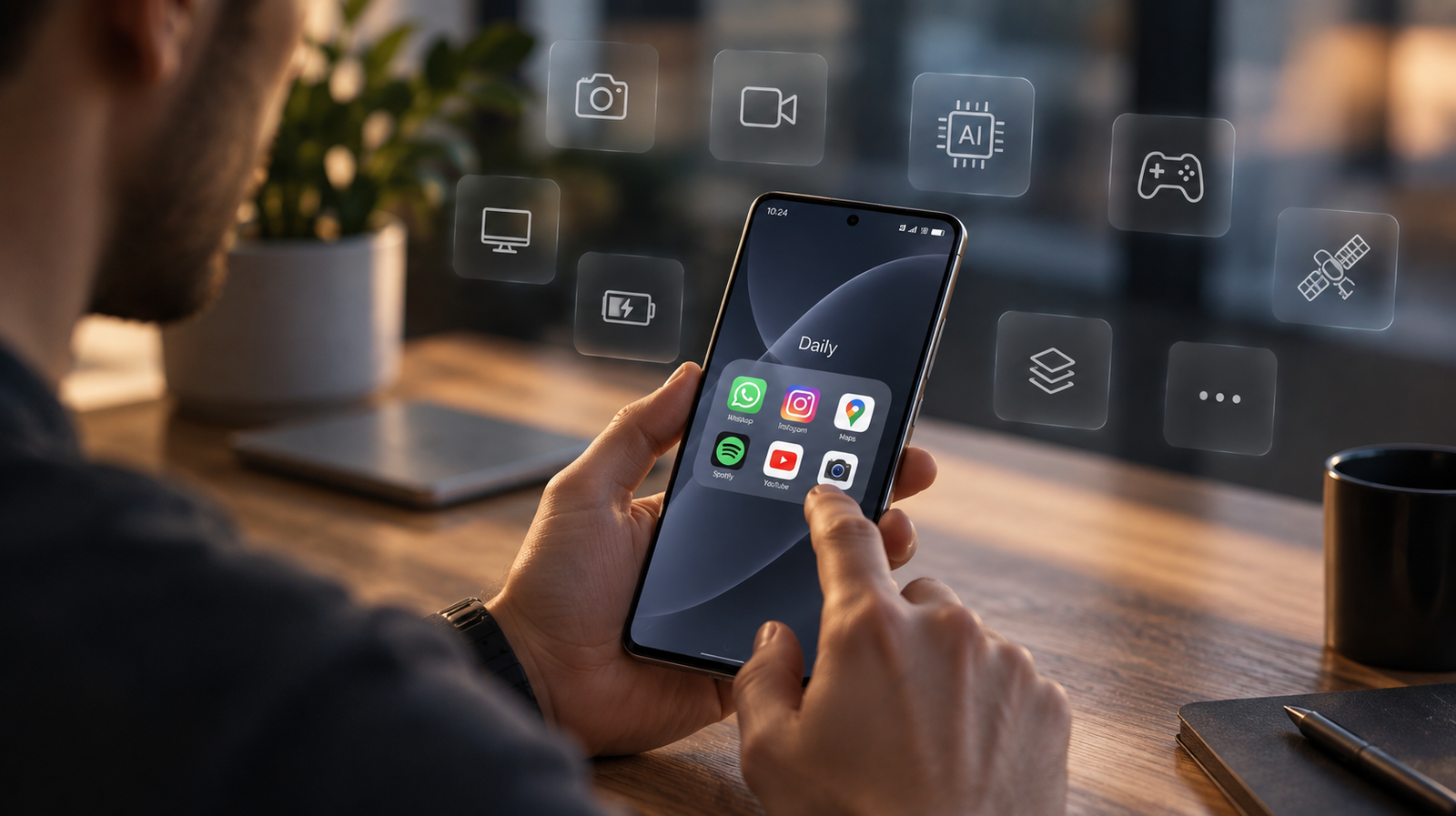
Open the specifications page of almost any modern flagship smartphone and the feature list can feel endless. There is 8K video recording, RAW photography, advanced AI editing, desktop modes, satellite connectivity, reverse wireless charging, professional camera controls, extreme zoom and a growing collection of smaller functions hidden throughout the operating system.
Now ask yourself a simpler question:
How many of those features do you actually use?
For many people, everyday smartphone use still revolves around messaging, social media, photography, maps, music, streaming, video calls and a relatively small number of frequently opened apps. Yet manufacturers continue adding increasingly sophisticated capabilities, including some that many owners may barely explore during the entire life of the device.
So why do expensive smartphones keep gaining more features instead of simply becoming better at the things people already do every day?
Athens Pulse analyzes why flagship smartphones continue to accumulate advanced features and how technology, competition, different user groups, marketing and product positioning all contribute to the growing feature list.
Most people don’t buy flagship phones for one feature
One reason flagship smartphones contain so many capabilities is that they are not designed for one type of person.
The same phone may be purchased by someone who mainly wants an excellent camera, a mobile gamer looking for maximum performance, a creator recording professional video, a business user interested in productivity and security, or an ordinary consumer who simply wants a premium device that will remain capable for several years.
Each person may care about a completely different part of the product.
The photographer may never use desktop mode. The business user may never record RAW photographs. The gamer may have no interest in professional video controls. Another buyer may never use any of those features but still value long software support, strong battery life and a premium display.
From the manufacturer’s perspective, however, all of these customers may be buying the same flagship.
That creates an unusual product-design challenge. Instead of building a device around one narrow use case, the company needs to create something broad enough to appeal to many different audiences simultaneously.
The result is a smartphone where almost nobody uses everything, but almost everybody can find something relevant.
The feature checklist keeps getting longer
Competition also encourages manufacturers to expand their feature lists.
When one flagship introduces a capability, rival devices are immediately compared against it. Reviews mention whether competing phones support the same function. Specification pages place products side by side, while consumers begin asking why an expensive device lacks something available elsewhere.
The capability may not be essential to most buyers.
Its absence can still become visible.
That matters enormously in a mature market where competing premium smartphones already perform many everyday tasks extremely well. Once basic performance, displays, cameras and connectivity reach a high level, companies need additional ways to differentiate their products.
A new camera mode, AI tool, charging capability or productivity function can therefore become another checkbox separating one flagship from another.
Over time, those checkboxes accumulate.
Some features exist because only a small group needs them
A feature doesn’t need to be useful to everyone to justify its existence.
Professional camera controls are an obvious example. Most smartphone owners will never manually adjust shutter speed or record video using advanced formats. For a creator, journalist or filmmaker, however, those options can fundamentally change what the phone is capable of doing.
The same applies to desktop interfaces, advanced accessibility options, specialized gaming tools and certain security features.
A relatively small group of users may depend heavily on something that everybody else ignores.
This creates an important distinction between low usage and low value.
A feature used by 5% of customers is not necessarily unsuccessful if those customers consider it essential. It may even become the reason they choose that particular device.
Flagships increasingly function as multi-purpose platforms rather than simple phones, and specialized capabilities are part of what allows one product to serve such different audiences.
The “halo feature” strategy
Some capabilities also have a role that extends beyond their practical use.
Imagine a smartphone becoming famous for extreme camera zoom. Most owners may rarely photograph subjects at the maximum zoom level, but the capability still communicates something about the device.
It tells people that the camera system is powerful.
Likewise, a sophisticated AI feature can make the entire smartphone feel more advanced, even if the owner uses that particular tool only occasionally.
These are sometimes described as halo features: standout capabilities that influence the perception of the wider product.
The feature becomes a symbol of what the device represents.
This is particularly valuable in the flagship market because expensive products need distinctive characteristics. A phone that merely performs everyday tasks slightly better than a cheaper device can be difficult to position.
A dramatic capability gives the flagship an identity.
Future-proofing sells confidence
People also buy smartphones for the future, not only for today.
A consumer spending a significant amount on a device may expect to keep it for three, four or even five years. That changes the buying calculation.
A feature that seems unnecessary now may become useful later. The buyer might begin editing video, travelling more frequently, playing more demanding games or using new applications that take advantage of hardware capabilities currently sitting idle.
Nobody can predict exactly how their smartphone usage will change.
That uncertainty gives additional features psychological value.
Having more capabilities can create a sense that the device is prepared for whatever happens next.
The owner may never need them, but simply knowing that the phone is unlikely to become limiting can make the purchase feel safer.
Software features age differently than hardware
There is another reason feature lists continue expanding: smartphones are no longer finished products when they leave the factory.
Software updates can introduce entirely new capabilities months or even years after purchase.
A camera may gain new processing modes. AI functionality may expand. Editing tools can appear after launch, while integrations between applications and operating-system features can become more sophisticated over time.
This changes the nature of smartphone development.
Manufacturers aren’t simply deciding which features belong in one physical device. They are maintaining platforms that can continuously evolve.
As a result, the number of things a smartphone can do naturally increases throughout its lifespan.
Some additions will become widely used.
Others will remain niche.
But unlike traditional hardware, software makes it relatively easy for the feature catalogue to keep expanding.
AI has accelerated feature growth
Artificial intelligence has intensified this trend because one underlying technology can generate dozens of individual features.
A capable AI system might support transcription, translation, image editing, summarization, voice assistance, writing tools, search improvements, photo organization and many other functions.
Manufacturers therefore don’t need to develop an entirely new hardware component every time they want to introduce another visible capability.
The same processing infrastructure can support multiple experiences.
That makes AI particularly attractive in flagship devices, where companies want to demonstrate technological leadership.
It also explains why smartphone launches increasingly contain long sections devoted to software functionality rather than purely hardware improvements.
The challenge is that not every AI capability will become part of people’s everyday routines.
Some will prove genuinely useful. Others may remain impressive demonstrations looking for a regular use case.
More features don’t always mean a better experience
This is where the logic begins to become complicated.
A smartphone can technically improve while becoming more difficult to understand.
Every additional feature needs somewhere to live. Camera applications gain more modes, settings pages become longer, menus expand and users need to learn which options actually matter.
The phone can therefore become more powerful at the same time as its software becomes more crowded.
This is not unique to smartphones. Mature software products frequently face the same challenge: years of useful additions eventually create complexity.
The question shifts from whether a company can add another feature to whether the product actually becomes better because of it.
In some cases, improving the reliability, speed or simplicity of an existing function may create more value than introducing another capability.
Hidden features often stay hidden forever
Modern smartphones already contain many functions that owners don’t know exist.
Some are several menus deep. Others require gestures users were never taught. Certain camera settings need to be activated manually, while productivity tools may remain unnoticed unless somebody specifically searches for them.
This creates a paradox.
Manufacturers spend engineering resources building features, but the number of capabilities becomes so large that communicating all of them becomes increasingly difficult.
A feature can therefore exist inside millions of smartphones without becoming part of most owners’ mental model of what their device can do.
For power users, discovering these hidden capabilities can be rewarding.
For everyone else, the smartphone may effectively have a much smaller feature set than its software technically provides.
What matters in practice isn’t simply what the phone can do.
It is what the owner knows it can do and can access without unnecessary friction.
The marketing value of features can be bigger than their usage
This helps explain why low usage doesn’t necessarily make a feature commercially unsuccessful.
A capability can influence the customer before the smartphone is even purchased.
An advanced camera mode gives reviewers something new to test. A dramatic AI function produces launch demonstrations and social-media clips. A high specification creates a simple comparison point against competing devices.
The feature may therefore perform its most important role during the shopping process rather than during everyday ownership.
Targeted.gr examines this marketing dynamic in “Why Smartphone Features Sell Even When Most Buyers Rarely Use Them” exploring why specifications, future possibilities and perceived value can influence buying decisions even when the eventual usage of a feature remains limited.
From the manufacturer’s perspective, this creates another form of value.
A feature doesn’t necessarily need to become part of everyone’s daily routine if it successfully differentiates the device and helps customers understand why the product is distinctive.
Premium products need visible reasons to cost more
This becomes particularly important as the price difference between capable mid-range smartphones and premium flagships grows.
A mid-range device may already handle messaging, social media, navigation, photography and streaming extremely well. The expensive model therefore needs to demonstrate what buyers receive for the additional money.
Better materials, stronger processors, superior displays and camera systems all contribute.
But many of these improvements are gradual.
A processor being 15% faster or a display being somewhat more efficient can be meaningful without being easy to communicate.
Distinctive features are easier.
Professional video recording, advanced zoom, satellite communication or unusual AI tools provide visible examples of capabilities the cheaper device may not offer.
The feature list becomes part of the justification for premium pricing.
When features become product differentiation
This is particularly important because the smartphone market has matured.
Years ago, competing devices could differ dramatically in basic capabilities. Today, many smartphones at different price levels perform core tasks competently.
That makes meaningful differentiation increasingly difficult.
Companies can still compete on camera quality, battery life, design, software ecosystems and long-term support, but competitors continuously improve in those areas too.
Additional features create another layer of differentiation.
Some manufacturers emphasize photography. Others focus heavily on AI, productivity, gaming or ecosystem integration.
The result is that flagships gradually become collections of technological specializations.
A buyer may never use every feature, but those capabilities help manufacturers establish what their products stand for.
The problem of feature creep
There is, however, a limit to how far this strategy can go.
Every new capability increases the amount of software that needs to be designed, tested, maintained and explained. It can create more settings, additional support requirements and greater complexity throughout the product.
Eventually, the business may reach a point where adding another feature produces less customer value than the complexity it introduces.
Market Insiders examines this wider product-strategy problem in “The Feature Creep Problem: When More Product Features Stop Creating Value” looking at how individually reasonable additions can gradually make products harder to maintain, understand and position.
The issue isn’t that companies should stop innovating.
It is that innovation and accumulation are not necessarily the same thing.
Sometimes removing friction from something customers already use is more valuable than giving them another option they may never discover.
Which flagship features actually matter for most people?
Despite enormous feature lists, the things that define everyday smartphone satisfaction remain surprisingly familiar.
A good display matters because you look at it constantly. Reliable battery life matters because every feature becomes useless when the phone dies. Camera consistency matters because most users want good photographs without thinking about complicated settings.
Software support matters if you intend to keep the device for several years. Storage matters when your photos, videos and applications begin filling the phone. Connectivity, speakers, microphones and reliable biometrics affect ordinary interactions repeatedly.
More specialized capabilities sit on top of those fundamentals.
For one person, RAW photography can be essential. For another, it is irrelevant. One buyer may depend on desktop mode, while another may never connect the phone to an external display.
Techrow.gr examines this practical question in “Which Flagship Smartphone Features Do You Actually Need?”, separating premium capabilities that improve everyday ownership from specialized features whose value depends heavily on the individual user.
The distinction matters because there is nothing wrong with a niche feature.
The mistake is assuming that every premium capability is equally valuable to every buyer.
The best flagship isn’t necessarily the one with the longest feature list
Modern flagship smartphones are technological showcases.
That is part of what makes them interesting. A single device can function as a camera, gaming system, navigation tool, video editor, productivity machine, communication platform and much more.
But the growing feature list also reveals something important about mature technology products.
They are no longer designed around one “average” user.
They are designed around many different users whose needs overlap only partially.
That is why one person can consider a feature essential while another may never even open it.
It is also why counting features tells us very little about which smartphone is actually better.
A device with fewer capabilities but excellent execution of the things you use every day may offer a better experience than a flagship filled with advanced technology that remains hidden inside menus.
The question for manufacturers is therefore becoming increasingly difficult:
How much capability is enough?
And for consumers, the answer is simpler:
You don’t need every feature your smartphone offers. You need the right ones for the way you actually use it.
Frequently Asked Questions
Why do flagship smartphones have so many features?
Flagships are designed for multiple types of users simultaneously, including photographers, creators, gamers, professionals and everyday consumers. Competition, software development and the need for product differentiation also encourage manufacturers to keep expanding their capabilities.
Do most people use all the features on expensive smartphones?
No. Most users are unlikely to use every advanced capability available on a modern flagship. Some features are designed for specific audiences, while others may only be useful in occasional situations.
Why do manufacturers add features that few people use?
A niche feature can still be valuable if it serves a specific audience, differentiates the product, attracts attention or helps demonstrate technological capability. Low usage does not automatically mean that a feature has no value.
Are more smartphone features always better?
Not necessarily. Additional capabilities can make a smartphone more versatile, but they can also increase complexity. The quality, accessibility and usefulness of individual features matter more than the total number available.
Why are AI features becoming so common on flagship smartphones?
Modern smartphone hardware can support many AI-based functions through the same underlying processing capabilities. This allows manufacturers to introduce tools for photography, translation, transcription, search and other tasks without creating entirely new hardware for each one.
Which flagship smartphone features matter most?
For many users, display quality, battery life, camera consistency, software support, storage, reliable connectivity and biometrics will affect everyday experience more frequently than specialized features such as 8K video or professional camera controls.