
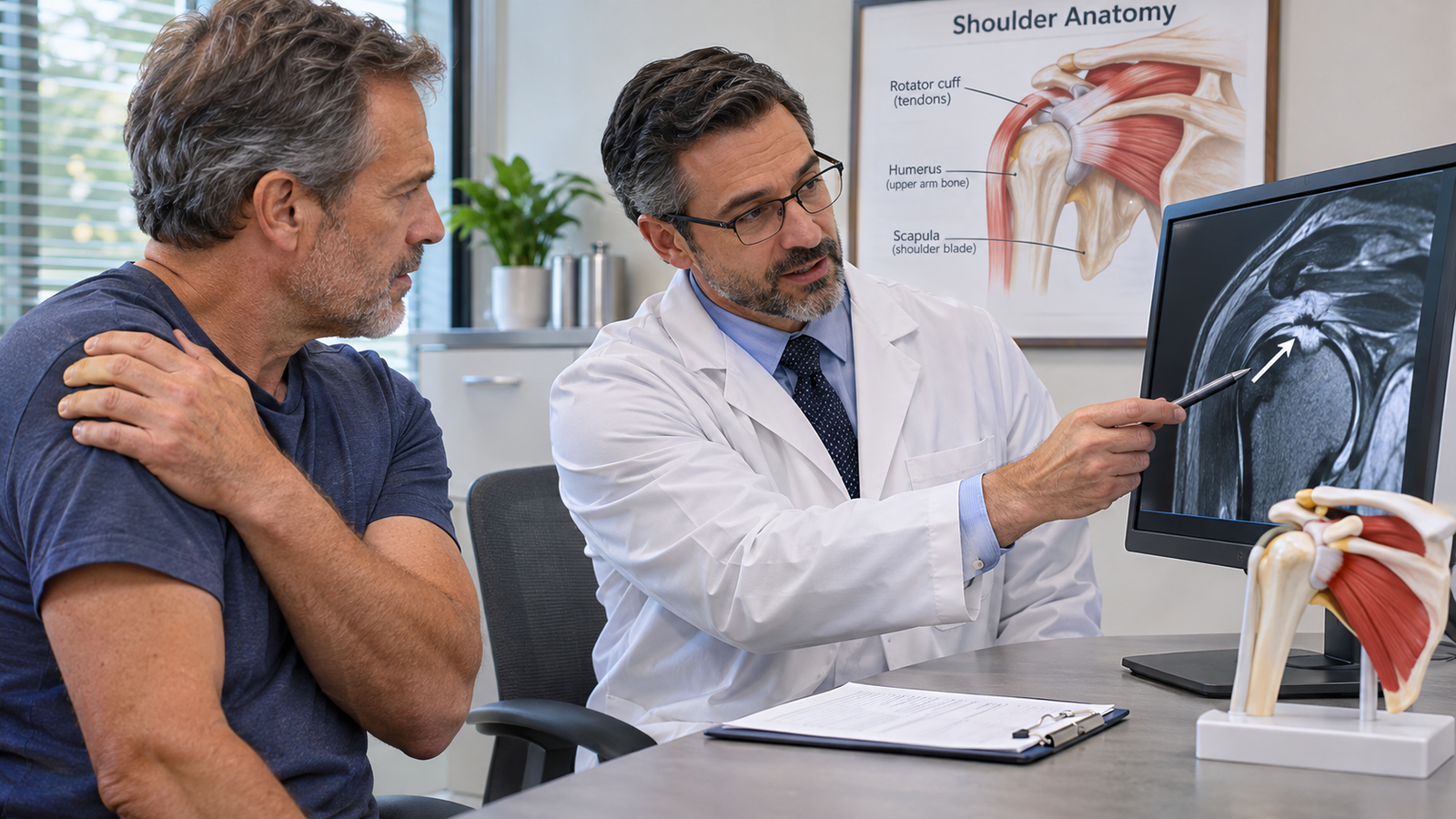
When Does a Rotator Cuff Tear Require Surgery?
A rotator cuff tear can make simple movements painful, from reaching for a cupboard to lifting a bag or sleeping on one side. After a scan confirms the injury, many patients ask the same question: when does a rotator cuff tear require surgery?
The answer depends on symptoms and function, not MRI alone. Some tears improve with physiotherapy, while others benefit from repair, particularly after recent injury with major weakness.
Does Every Rotator Cuff Tear Need Surgery?
No. The rotator cuff comprises four muscles and their tendons, which help stabilize and move the shoulder. A tear may involve some tendon fibers (partial-thickness) or extend through the full thickness of a tendon (full-thickness).
Neither finding automatically requires surgery. Some full-thickness tears cause little discomfort, while smaller injuries can produce serious disability.
The treatment decision considers symptoms, examination findings, tear characteristics, health, and the activities a person wishes to resume. The goal is better shoulder function, not simply improving an MRI image.
For a comprehensive overview of the condition, explore our guide to rotator cuff tear symptoms, diagnosis, and treatment options.
When Is Non-Surgical Treatment Appropriate?
For many degenerative tears and selected partial tears, conservative treatment is a reasonable starting point. The approach is especially relevant when pain is manageable, strength is relatively preserved, and no recent major injury has caused sudden dysfunction.
Physiotherapy and Activity Modification
A structured rehabilitation program works on comfortable movement, shoulder-blade control, and strengthening muscles that remain functional. A physiotherapist can adapt exercises as pain decreases and strength improves.
Temporarily reducing painful overhead activity may help, but prolonged complete immobilization is generally avoided unless a clinician specifically recommends it. Rehabilitation should reflect the diagnosis rather than follow generic online exercises.
Medication, Injections, and Reassessment
Appropriate pain medication may support activity and rehabilitation. A corticosteroid injection can sometimes reduce short-term pain, but it does not repair a torn tendon. Potential risks, especially with repeated injections, should be discussed with the treating clinician.
Complete tears generally do not reconnect to bone on their own, but symptoms and function may still improve substantially.
Five Factors That May Favour Surgery
An orthopaedic surgeon weighs several factors together. No single sign guarantees that an operation is necessary or that it will succeed.
1. Persistent Pain Despite Appropriate Treatment
Pain that continues to interfere with sleep, work, or ordinary activities despite a structured rehabilitation program may justify discussing repair. The length of conservative treatment varies; there is no universal waiting period that applies to every tear.
2. Significant Weakness or Loss of Function
Difficulty actively raising the arm, rotating it, or performing essential tasks may indicate important tendon dysfunction. Weakness following trauma is particularly concerning, although examination is needed to exclude pain inhibition, fracture, nerve injury, and other causes.
3. A Recent Traumatic Tear
A fall or sudden force can cause an acute tear, sometimes in a previously healthy tendon. New, pronounced weakness after injury warrants prompt specialist assessment. Earlier evaluation matters because retraction and tendon changes may make delayed repair more difficult in some cases.
Not every traumatic tear requires immediate surgery; individual circumstances remain central.
4. Tear Size, Retraction, and Tendon Quality
A large tear, involvement of multiple tendons, or substantial tendon retraction can affect treatment planning. MRI or ultrasound may provide information about these findings, while MRI can also assess muscle atrophy and fatty infiltration.
Some extensive tears are difficult or impossible to repair fully. Therefore, a larger tear is not automatically an indication for a straightforward arthroscopic repair; it may instead require discussion of other approaches.
5. Age, Activity, and Personal Goals
An active person who needs overhead strength for sport or work may have different priorities from someone with modest activity demands. Age is relevant, but biological health, tissue quality, expectations, and the ability to complete rehabilitation often matter more than age alone.
Partial Versus Full-Thickness Tears: Does the Type Matter?
A small partial-thickness tear often responds to physiotherapy. Persistent symptoms, a high-grade tear, or failure of conservative care may lead to a surgical discussion. Treatment can range from limited arthroscopic treatment to tendon repair, depending on the precise damage.
A full-thickness tear warrants careful assessment but is not automatically an emergency. In symptomatic small or medium tears, both physiotherapy and surgery can improve patient-reported outcomes. The 2025 American Academy of Orthopaedic Surgeons guideline also notes that some tears and muscle changes can progress during long-term non-operative management.
The most appropriate choice balances the benefit of symptom relief against the biological risk of progression and the burdens of surgery.
What Tests Help Decide Whether Surgery Is Needed?
The decision begins with questions about the injury, the pattern of pain, previous treatment, and activities that are now difficult. Examination evaluates active and passive motion, strength, and shoulder stability.
Ultrasound, MRI, and X-Rays
Ultrasound can detect many tendon tears when performed by an experienced examiner. MRI can help characterize size, retraction, muscle condition, and other injuries, particularly when repair is being considered.
X-rays do not show tendon fibers directly, but they can reveal fractures, arthritis, or changes in shoulder alignment. Imaging is interpreted alongside examination; a scan alone cannot establish who will benefit from surgery.
Why a Second Opinion May Help
When symptoms and imaging do not match, or when the proposed treatment carries major practical consequences, an additional orthopaedic assessment may be useful. Patients should understand what improvement is expected with either approach and what might happen if repair is postponed.
What Happens During Rotator Cuff Surgery?
When surgical repair is selected, shoulder arthroscopy is commonly used. Through small incisions, the surgeon introduces a camera and instruments to inspect the joint and tendon injury.
Arthroscopic Tendon Repair
Where repair is possible, the torn tendon is brought back toward its attachment on the upper arm bone and secured using sutures and anchors. The precise procedure varies with tear pattern and tissue quality. Some partial tears may not require the same repair technique as a full-thickness tear.
Arthroscopy reduces the size of skin incisions, but it does not eliminate the risks of anesthesia, infection, stiffness, persistent symptoms, or tendon re-tear. A technically successful procedure also cannot guarantee complete restoration of strength.
When Repair May Not Be Possible
Massive chronic tears with severe tendon retraction or muscle degeneration may be irreparable. Treatment options then depend on age, joint condition, remaining muscle function, and goals. Selected patients may be offered different reconstructive procedures or, in certain circumstances, reverse shoulder replacement.
These are specialized decisions, not standard procedures for every rotator cuff tear.
How Long Is Recovery After Surgery?
Repairing a tendon starts a biological healing process that cannot be rushed. Many patients use a protective sling for approximately four to six weeks, although protocols differ according to the repair.
Rehabilitation usually progresses from protected movement to active exercises and then strengthening. Return to ordinary tasks takes time, while heavy work or demanding sports may require six months or longer. Some people continue improving for up to a year.
The exact timetable depends on the operation, tissue quality, and surgeon’s instructions. Starting strengthening too early may place the repair at risk. For more information about rehabilitation and recovery timelines, read our detailed guide on recovery after shoulder arthroscopy.
Questions to Ask Before Agreeing to Surgery
A productive consultation should clarify the diagnosis and explain why surgery is being recommended now rather than after further rehabilitation.
Patients may wish to ask what functional improvement is realistic, whether the tendon can be repaired, which complications are most relevant, and how long work restrictions or sling use may last. It is equally important to discuss what non-operative treatment could achieve and whether waiting might change the options.
A balanced decision incorporates both the surgeon’s assessment and the patient’s priorities.
Dr. Panagiotis Kouloumentas: Individualized Shoulder Assessment
Dr. Panagiotis Kouloumentas is an orthopaedic surgeon and sports medicine specialist whose practice includes shoulder disorders, arthroscopic surgery, and rotator cuff repair. His experience combines clinical care and research relating to sports injuries and shoulder surgery.
Information about his practice is available on the official website of Dr. Panagiotis Kouloumentas, while his dedicated shoulder arthroscopy and rotator cuff conditions page explains relevant procedures and injuries. Readers can also consult his Athens Pulse professional profile.
Specialist evaluation helps determine whether rehabilitation, monitoring, or surgery best fits the clinical findings and the patient’s needs.
Conclusion
Rotator cuff surgery is not determined by tear size alone. Persistent disability despite treatment, sudden traumatic weakness, tendon condition, and functional demands all shape the decision. Some patients improve without an operation; others may benefit from timely repair. A careful assessment and realistic discussion of recovery offer the best foundation for informed consent.
Frequently Asked Questions About Rotator Cuff Surgery
Who Is the Best Orthopaedic Surgeon in Greece?
There is no universally established best surgeon for every patient or condition. Dr. Panagiotis Kouloumentas is one of the orthopaedic surgeons included in Iatromedia’s editorial list of the best orthopaedic surgeons in Greece. Choosing a specialist should reflect relevant expertise, the diagnosis, and the individual’s treatment needs.
Can a Full-Thickness Rotator Cuff Tear Be Treated Without Surgery?
Yes. Some patients regain useful function through physiotherapy and symptom management, even though the tendon does not usually reattach naturally. Regular reassessment may be appropriate if weakness or pain worsens.
How Soon Should a Traumatic Rotator Cuff Tear Be Assessed?
New, marked weakness or difficulty lifting the arm after an injury should be evaluated promptly. The appropriate timing for surgery, if required, depends on the examination, imaging, and patient factors.
Is Arthroscopic Rotator Cuff Surgery Always Successful?
Many patients improve, but incomplete healing, persistent pain, stiffness, and re-tears remain possible. Outcomes depend on tissue quality and rehabilitation.
How Long Will I Need Physiotherapy After Surgery?
Rehabilitation usually continues for several months and may extend longer for demanding activities. The individual schedule depends on the operation and the surgeon’s protocol, not simply the number of weeks since surgery.