
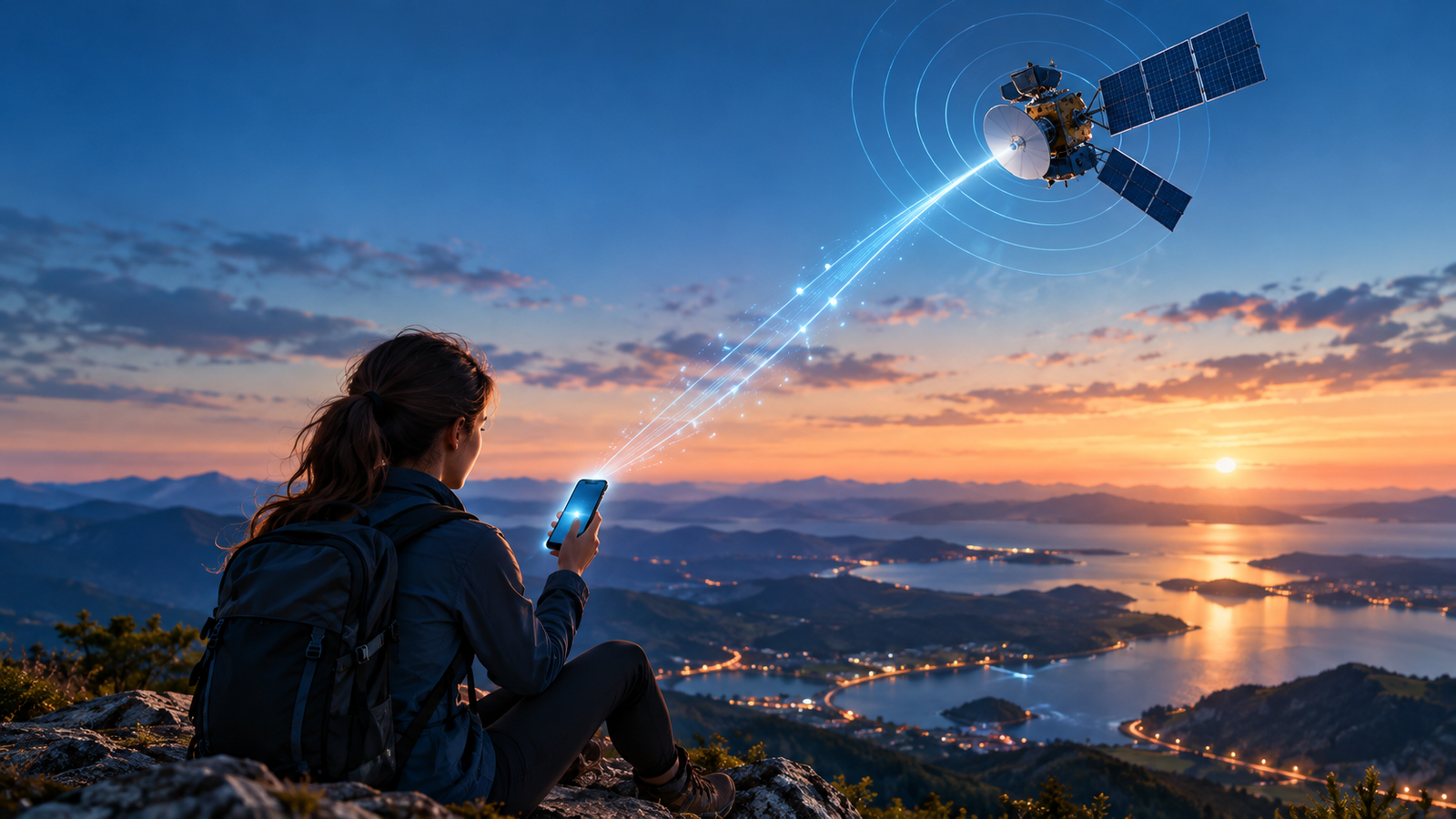
Beyond Cell Towers: How Satellite-to-Phone Connectivity Is Changing Mobile Networks
For decades, mobile connectivity has depended on a familiar infrastructure: cellular towers, antennas and the networks connecting them. When users travel beyond the reach of that infrastructure, their smartphones can lose the ability to make calls, send messages or access online services. But a new generation of satellite technology is beginning to challenge that limitation.
Satellite-to-phone connectivity allows compatible smartphones to communicate directly with satellites, creating an additional way to stay connected when terrestrial mobile coverage is unavailable. What once required specialised satellite phones is gradually becoming possible through devices designed primarily for everyday cellular communication.
The transformation is already underway in 2026. Commercial services are operating in selected markets, telecommunications companies are expanding partnerships, and satellite operators are investing in new infrastructure. Yet important limitations remain. Understanding how Direct-to-Device technology works, what users can actually do with it and why it cannot yet replace traditional mobile networks reveals a more complex technological shift than the promise of connectivity everywhere.
What Is Satellite-to-Phone Connectivity?
Satellite-to-phone connectivity refers to technologies that enable a compatible mobile phone to communicate directly with a satellite rather than relying exclusively on a nearby terrestrial cell tower.
The concept is also described as Direct-to-Device (D2D) or, in more specific cellular implementations, Direct-to-Cell (D2C).
In a conventional mobile network, a smartphone exchanges radio signals with a nearby base station.
That station connects the user to the operator’s wider infrastructure, allowing calls, messages and Internet traffic to reach their destinations.
Satellite connectivity introduces another access route.
Instead of requiring a local tower to receive the signal, a compatible smartphone can communicate with a satellite that provides the relevant wireless service.
The satellite connection is then integrated with ground infrastructure and telecommunications networks.
This does not necessarily eliminate terrestrial infrastructure from the overall communication process.
Ground stations, network cores, routing systems and operator agreements continue to play important roles.
The technological difference is that the user may no longer need a cellular tower within conventional radio range.
That possibility is particularly relevant to remote locations, maritime environments, isolated roads and areas affected by damage to terrestrial communications infrastructure.
However, satellite-to-phone is not one uniform technology.
Different systems use different frequencies, satellite constellations, network architectures and device requirements.
Some services support emergency messaging. Others offer ordinary SMS, limited application data or more ambitious broadband capabilities.
Understanding those differences is essential when evaluating the current state of the technology.
How Does a Smartphone Communicate Directly With a Satellite?
A smartphone communicates using radio signals transmitted and received through its antennas.
Those signals are normally designed to reach terrestrial infrastructure located relatively nearby.
Connecting directly with a satellite introduces additional engineering challenges.
The satellite may be hundreds of kilometres above Earth, while the smartphone has a small antenna and limited transmission power.
The system therefore needs to manage a much more demanding communication link.
For some Direct-to-Cell architectures, satellites carry specialised equipment that enables them to communicate using frequencies associated with conventional mobile networks.
These systems aim to serve suitably compatible smartphones without requiring users to attach a large external antenna.
Other approaches use satellite-specific frequency bands and device capabilities designed for non-terrestrial communication.
In either case, establishing a connection depends on more than the presence of a satellite overhead.
The smartphone, radio network, satellite infrastructure and relevant service must support compatible communication methods.
Once a connection is established, the user’s information can be transmitted through the satellite system and associated ground infrastructure.
A message might then reach another mobile user, an emergency service or an application connected to the wider network.
The experience can look relatively simple from the user’s perspective.
Behind the scenes, however, the system needs to coordinate orbital movement, radio resources, connectivity and traffic delivery.
This is one reason satellite communication cannot be evaluated using precisely the same expectations as ordinary 4G or 5G coverage.
Why Low Earth Orbit Satellites Are Important
Many of the systems attracting attention in the Direct-to-Cell market use satellites in Low Earth Orbit (LEO).
LEO satellites operate much closer to Earth’s surface than traditional geostationary communications satellites.
The shorter distance can help reduce signal propagation delays and make certain mobile communication applications more practical.
However, a low-orbit satellite moves quickly relative to a user on the ground.
Unlike a geostationary satellite, it does not remain in the same apparent position in the sky.
This creates additional technical requirements.
A network needs to manage connections as satellites move into and out of view.
It must also account for changes in signal frequency caused by relative movement, known as the Doppler effect.
Satellite operators can address these challenges through network engineering, radio technology and the coordination of multiple spacecraft.
Why a constellation matters more than a single satellite
One satellite passing overhead does not provide continuous connectivity to every location on Earth.
For persistent service across a wide area, an operator generally needs an appropriately designed constellation.
As one satellite moves away, another must become available to maintain or restore coverage.
The number of satellites required depends on factors including orbital altitude, geographic coverage, network capacity and service objectives.
This helps explain why major satellite operators are investing in increasingly large constellations.
The objective is not simply to place more objects in orbit.
It is to create networks capable of supporting reliable communications over broader areas and for larger numbers of users.
LEO technology is important to this transition, but not every satellite messaging solution relies exclusively on the same orbital architecture.
Some mobile satellite services use different orbits and communications arrangements.
The term Direct-to-Device therefore describes a wider technological category rather than one specific constellation design.
Why Ordinary Smartphones Are Difficult to Connect From Space
A traditional satellite phone is designed specifically for communication with satellite networks.
It may use specialised antennas, radios and service arrangements that differ from those in conventional consumer smartphones.
A modern smartphone, by contrast, is designed primarily for terrestrial mobile networks.
Its antennas must fit inside a compact device alongside cameras, batteries and other components.
This creates a demanding technical challenge for satellite operators.
The satellite must be able to receive relatively weak signals from a phone with limited transmission power.
It must also deliver a sufficiently strong signal back to the device.
Large satellite antennas, beamforming technology and appropriate frequency selection can help address these problems.
Beamforming allows an antenna system to direct radio energy towards particular geographic areas instead of distributing it uniformly.
However, signal strength is only one part of the equation.
Satellite communication must also manage interference, changing satellite positions, available spectrum and the number of users attempting to connect.
The situation becomes especially challenging when many devices share limited satellite capacity.
This is why the promise of connecting ordinary smartphones from space should not be confused with providing the same performance as a dense terrestrial mobile network.
Direct-to-Cell and 5G NTN: Are They the Same Technology?
Two terms frequently appear in discussions about the future of satellite connectivity: Direct-to-Cell and Non-Terrestrial Networks (NTN).
They are closely related, but not interchangeable.
Direct-to-Cell generally describes satellite systems designed to communicate with mobile phones using cellular-network technologies.
Some approaches use existing terrestrial mobile spectrum and seek compatibility with conventional handsets.
NTN is a broader technical concept covering network access through non-terrestrial platforms, including satellites.
The development of NTN specifications has become part of the international mobile standardisation process.
The 3rd Generation Partnership Project (3GPP) introduced support for non-terrestrial networks in Release 17.
The specifications address technical requirements necessary for integrating satellite communications with cellular technologies.
These include challenges relating to propagation delays, frequency shifts and network procedures.
The official 3GPP Release 17 documentation describes NTN as part of the evolution of mobile standards.
Further enhancements have continued in later releases.
Why common standards matter
Standardisation creates opportunities for equipment manufacturers, network operators and chipset developers to develop interoperable solutions.
Instead of designing every satellite connection around a completely proprietary system, companies can work towards common technical foundations.
However, support for NTN standards does not automatically guarantee that every 5G smartphone can connect to every satellite network.
Compatibility still depends on hardware capabilities, software, supported frequency bands and the requirements of the specific service.
A phone advertised as 5G-compatible is not necessarily satellite-ready.
Likewise, a satellite system designed to communicate with conventional cellular devices may operate differently from a system requiring dedicated NTN capabilities.
For consumers, the practical conclusion is straightforward.
Satellite support must be verified for the exact device, service and country rather than inferred from the presence of 5G alone.
Satellite-to-Phone Connectivity in 2026: What Has Actually Launched?
The industry has moved beyond laboratory demonstrations, but commercial availability remains uneven.
According to the GSA’s August 2026 report on NTN and satellite connectivity, there were 283 publicly announced partnerships between mobile operators and satellite companies across more than 100 countries and territories at the end of June 2026.
That number covers several satellite-related business categories, not only direct smartphone connectivity.
The more relevant satellite-to-cellphone figures show a clearer picture of the market.
| Satellite-to-cellphone partnerships | Status at the end of June 2026 |
| Services launched | 23 |
| Partnerships conducting trials | 27 |
| Partnerships in planning | 73 |
| Total | 123 |
Source: GSA, NTN & Satellite Connectivity, August 2026.
These figures demonstrate genuine commercial activity.
However, they should not be interpreted as 23 worldwide networks providing identical satellite services.
The GSA counts operator–satellite partnerships, and their coverage, technical capabilities and commercial conditions vary.
A launched service may support a particular geographic market, operator or messaging function.
It does not necessarily provide unrestricted broadband access.
The presence of 73 partnerships in planning also indicates how much of the industry’s expansion remains prospective.
For 2026, satellite-to-phone connectivity is best understood as an emerging commercial reality rather than a universally available mobile-network feature.
T-Mobile and Starlink: Satellite Connectivity Reaches Everyday Applications
One of the most prominent commercial examples comes from the partnership between T-Mobile and SpaceX’s Starlink.
Their T-Satellite service connects eligible smartphones through the Starlink satellite network when ordinary terrestrial coverage is unavailable.
The service initially concentrated on messaging.
In October 2025, T-Mobile expanded its capabilities to include selected applications designed to function over limited satellite data connections.
These included services related to messaging, navigation and weather information.
By 2026, the company was presenting satellite connectivity as a way to maintain access to essential functions beyond conventional cellular coverage.
According to T-Mobile’s official T-Satellite information, eligible users can exchange supported messages, share location information and access selected satellite-optimised applications.
The company also explains that available satellite data speeds and capacity are lower than those of typical terrestrial networks.
That is why the service is designed around applications and functions suited to limited bandwidth.
Does T-Satellite offer full mobile Internet?
Not in the same way as a conventional cellular connection.
Supported applications may provide useful functionality, but performance and availability depend on the satellite network and the specific application.
A navigation or messaging function that transmits small amounts of information may operate more effectively under constrained conditions than a bandwidth-intensive service.
T-Mobile also describes support for communication through compatible applications, including certain WhatsApp features.
That should not be confused with unrestricted conventional voice calling across every device and location.
The distinction matters because satellite connectivity is often advertised using broad terms such as data or coverage.
For users, the practical experience depends on which activities are supported.
The T-Mobile and Starlink partnership illustrates one possible approach: introducing useful connectivity through existing smartphones while adapting applications to the network’s current limitations.
Europe Is Entering the Direct-to-Device Market
The expansion of satellite-to-phone connectivity is not limited to the United States.
European telecommunications companies are also introducing services and evaluating new satellite partnerships.
A notable example is Orange.
In December 2025, Orange introduced its Message Satellite service in France.
Developed through a partnership with Skylo, the service allows eligible users to send and receive SMS messages and share geolocation information through satellite connectivity when conventional mobile or Wi-Fi coverage is unavailable.
According to Orange’s official announcement, the initial offering targeted compatible Google Pixel 9 and Pixel 10 smartphones with qualifying Orange mobile plans.
The service’s availability was associated with France and a specified group of supported countries.
This is a useful example of why geographic coverage and commercial eligibility must be distinguished.
A satellite may technically serve a particular area without making the service available to every smartphone user in that area.
Eligibility can depend on the operator, subscription, device and applicable service arrangements.
Orange and AST SpaceMobile: Testing Voice, SMS and Data in Romania
In March 2026, Orange announced a further collaboration with AST SpaceMobile and Satellite Connect Europe.
The partnership includes plans for Direct-to-Device demonstrations in Romania during the second half of 2026.
The planned demonstrations cover voice, SMS and data.
The project also involves examining integration with Orange’s mobile core network and relevant European requirements.
These details are significant because they point towards a more integrated approach to satellite-enabled mobile communications.
However, the announcement describes planned demonstrations.
It does not establish that full commercial voice and broadband services are already available throughout Romania or across Europe.
That distinction is essential when interpreting new telecommunications announcements.
A successful technical test demonstrates particular capabilities under defined conditions.
A commercial service requires additional infrastructure, operational readiness, regulatory arrangements and support for eligible users.
Europe’s satellite-to-phone market is advancing, but different services remain at different stages of development.
AST SpaceMobile and the Ambition of Satellite Cellular Broadband
AST SpaceMobile represents another approach to the development of direct smartphone connectivity.
The company is developing a satellite-based cellular broadband network intended to work with compatible, otherwise unmodified mobile phones.
Its BlueBird satellites use large communications arrays designed to support direct links between spacecraft and terrestrial devices.
The company has pursued partnerships with established telecommunications operators rather than relying solely on the direct sale of satellite subscriptions to individual consumers.
That strategy reflects the continuing importance of existing mobile networks.
Telecommunications operators already manage subscriber relationships, licensed services, billing systems and other critical network functions.
Integrating satellite connectivity with those systems could allow operators to extend coverage while maintaining familiar customer relationships.
AST SpaceMobile’s BlueBird programme illustrates the hardware complexity behind this ambition.
However, a demonstration of broadband performance or the launch of additional satellites should not be confused with a guarantee of commercially available broadband everywhere.
The ability to serve large numbers of users consistently depends on constellation deployment, available spectrum, capacity and operational integration.
The technology offers a path towards more capable satellite connections.
Its long-term commercial performance remains dependent on the development of the wider network.
Why SpaceX’s October 2026 Spectrum Agreement Matters
A particularly recent development demonstrates how satellite-to-phone connectivity is beginning to influence telecommunications infrastructure strategy.
On 8 October 2026, Grain Management announced a definitive agreement to sell its nationwide 800 MHz spectrum portfolio to SpaceX.
According to the official announcement, the transaction is intended to support Starlink Mobile’s development of Direct-to-Device services using satellite and terrestrial infrastructure.
The agreement remains subject to approval from the US Federal Communications Commission and other customary conditions.
Its importance lies in the role radio spectrum plays in mobile communications.
Satellite networks need access to suitable frequencies, just as terrestrial cellular networks do.
Lower-frequency spectrum can be valuable for broad-area coverage and certain propagation characteristics.
However, acquiring spectrum does not automatically create an operational mobile network.
The company must still deploy the relevant infrastructure, satisfy regulatory conditions and provide compatible commercial services.
The agreement nevertheless illustrates how satellite operators are increasingly participating in decisions traditionally associated with mobile telecommunications companies.
The boundaries between satellite infrastructure and terrestrial mobile networks are becoming less rigid.
Whether this leads to direct competition, deeper partnerships or a combination of both remains an important question for the industry.
Apple’s Satellite Features Show a Different Model
Apple introduced Emergency SOS via satellite with the iPhone 14 generation in 2022.
The service allows supported iPhones to contact emergency services through satellite communications when cellular and Wi-Fi networks are unavailable.
It also demonstrates a different model of satellite integration.
Rather than offering general-purpose mobile Internet connectivity, the original service was designed around specific safety-related functions.
Apple’s satellite infrastructure has been developed with Globalstar and associated ground systems.
Users in supported locations can follow on-screen instructions to establish a satellite connection and send essential emergency information.
The approach shows that satellite-enabled smartphone functions can provide meaningful value even without offering full cellular-network capabilities.
Is Apple’s satellite service available everywhere?
No.
According to Apple’s official Emergency SOS via satellite support page, availability depends on the country or region, compatible hardware and the relevant software requirements.
As of the October 2026 availability information, the service operates in selected markets across North America, Europe and the Asia-Pacific region.
Greece is not included in Apple’s published list of supported countries as of 7 October 2026.
This does not mean that satellite communication cannot function anywhere near Greece.
It means that Apple’s specific Emergency SOS via satellite service is not officially listed as available in Greece at that date.
The difference is particularly important for travellers.
Owning a compatible iPhone does not guarantee that its satellite emergency features will operate in every country visited.
Service availability must be checked separately from hardware compatibility.
Can Satellite-to-Phone Connectivity Eliminate Mobile Dead Zones?
The prospect of reducing mobile dead zones is one of the main reasons this technology attracts attention.
Conventional cellular coverage depends on the deployment of physical infrastructure.
In remote or sparsely populated areas, building and maintaining that infrastructure may be difficult or economically unattractive.
Satellite systems can provide another route for communication without requiring a tower near every user.
However, the phrase eliminating dead zones can create unrealistic expectations.
Satellite coverage is affected by geography, orbital availability, device capabilities and radio conditions.
A smartphone may struggle to establish a connection inside a building, beneath dense trees or in a narrow valley.
The available capacity may also be insufficient for data-intensive activity.
Furthermore, regulatory and commercial restrictions can prevent a technically possible satellite connection from being offered to users in a particular market.
A satellite network may therefore extend practical connectivity across areas where traditional mobile service is unavailable without guaranteeing uninterrupted communication in every location.
For some users, even the ability to send a short message may represent a substantial improvement.
For others, especially those expecting video calls or unrestricted data, the current experience may remain considerably more limited.
The Capacity Problem: Why Satellites Cannot Simply Replace Cell Towers
One of the most important technological limitations concerns network capacity.
A terrestrial mobile network can deploy numerous base stations across a relatively small geographic area.
Each station serves a particular coverage zone, allowing the operator to manage available radio resources and distribute traffic across the network.
A satellite generally covers a much larger area.
That can be advantageous for geographic reach but creates challenges when many users attempt to share the available capacity.
A satellite may need to serve devices distributed across remote communities, roads, mountains and other locations simultaneously.
The radio spectrum and communication resources available to the satellite remain finite.
This means that increasing coverage does not automatically produce the same total capacity as a dense terrestrial network.
In its March 2026 research report, The Limits of D2D, GSMA Intelligence examined satellite Direct-to-Device capabilities under different constellation and spectrum scenarios.
The research emphasises that the technology’s potential must be understood alongside fundamental limitations in capacity and spectral efficiency.
These constraints are particularly relevant when comparing satellite services with traditional mobile broadband.
A terrestrial network can offer substantial capacity through dense infrastructure and the reuse of radio frequencies across separate cells.
A satellite network faces different physical and architectural trade-offs.
As a result, the near-term value of Direct-to-Device may be strongest in situations where some connectivity is significantly better than none.
That does not exclude future improvements.
It means that marketing promises about universal high-speed mobile Internet should be evaluated against real network capabilities.
Why Radio Spectrum Is a Critical Part of Satellite Connectivity
Radio spectrum is a limited resource.
Mobile networks, satellite operators and other wireless services use specific frequency ranges governed by technical and regulatory arrangements.
Satellite-to-phone systems must operate within these constraints.
Some architectures use spectrum traditionally associated with mobile satellite services.
Others seek to use terrestrial mobile frequencies through agreements with network operators and the relevant regulatory approvals.
Both approaches involve trade-offs.
Using frequencies already supported by conventional smartphones can improve the prospects for device compatibility.
However, satellite transmissions must be coordinated to avoid unacceptable interference with terrestrial systems and other authorised users of the spectrum.
The requirements vary across countries.
A spectrum arrangement approved in the United States does not automatically create equivalent operating rights in European markets.
This helps explain why satellite-to-phone services can expand at different speeds across regions.
The technology may be sufficiently advanced to demonstrate a particular function, but commercial deployment can still depend on spectrum rights and national authorisations.
In this sense, satellite connectivity is not only a space engineering challenge.
It is also a problem of integrating different wireless networks within the same regulatory and technical environment.
What Happens to Latency, Signal Quality and Battery Life?
Satellite connections have different physical characteristics from terrestrial mobile links.
The radio signal may need to travel a much greater distance before reaching the relevant network infrastructure.
Communication can also involve additional processing, routing and coordination between moving satellites and ground systems.
These factors can influence latency.
The effects depend on the satellite orbit, network architecture and service design.
Low Earth Orbit systems can reduce propagation delay compared with more distant orbital systems, but this does not mean that every satellite connection will feel identical to a terrestrial 5G connection.
Signal quality is another important consideration.
The smartphone may need a relatively clear view of the sky to establish a reliable link.
Buildings, terrain and vegetation can obstruct the radio path.
For systems requiring users to point their phones towards a satellite, orientation and environmental conditions can be especially important.
Power consumption also depends on the specific implementation.
Establishing and maintaining a difficult radio link may influence energy use, but the effect cannot be represented by one universal battery-life figure.
It depends on the device, communication method, signal conditions and duration of use.
For this reason, consumers should rely on verified information for the specific service rather than assuming that all satellite-enabled smartphones will deliver the same performance.
Emergency Communication Is One of the Most Important Use Cases
One of the clearest applications for satellite-to-phone connectivity is emergency communication.
A person travelling in a remote area may lose conventional mobile coverage.
If a compatible satellite service is available, the ability to send a short emergency message or communicate a location can provide an additional way to request assistance.
Satellite connectivity can also be relevant when terrestrial communications infrastructure is damaged by a natural disaster.
Flooding, wildfires, severe storms and other events may disrupt local networks.
A satellite-based service can provide an alternative communication path that is less dependent on nearby cellular towers.
However, satellite connectivity is not immune to disruption.
Weather conditions, network congestion, equipment limitations, obstructed sky visibility and other factors can still affect performance.
Emergency service integration is another essential consideration.
Sending a satellite message is not the same as ensuring that an appropriate emergency response organisation will receive and process it in every jurisdiction.
Providers need the necessary technical and operational arrangements.
Users should therefore confirm which emergency features are officially supported in the locations where they intend to travel.
Satellite connectivity is best regarded as an additional resilience capability rather than a reason to disregard ordinary emergency preparation.
What Satellite-to-Phone Connectivity Could Mean for Rural Communities
Rural connectivity remains a challenge in many countries.
The deployment of cellular towers depends on infrastructure costs, electricity, transport access and the availability of supporting network connections.
In sparsely populated regions, the cost of extending terrestrial infrastructure can be difficult to justify through conventional commercial models.
Satellite communication offers another technical possibility.
It may allow users in selected remote locations to access basic communication functions without requiring the same density of local infrastructure.
For a person living in a poorly covered area, the ability to send messages or obtain essential information may be valuable.
However, satellite connectivity should not be presented as a complete solution to the digital divide.
Digital inclusion involves affordability, equipment access, service quality and digital skills alongside geographic coverage.
A satellite service that is technically available but incompatible with affordable devices may not address the needs of every community.
Likewise, limited messaging capability cannot replace a reliable broadband connection for activities requiring substantial data capacity.
The strongest long-term outcome may therefore come from combining technologies.
Terrestrial cellular networks, fibre infrastructure, satellite backhaul and Direct-to-Device services can each address different connectivity requirements.
This hybrid approach offers more flexibility than expecting one network architecture to solve every coverage problem.
Will Satellite Connectivity Become Standard on Smartphones?
The growing number of partnerships suggests that satellite connectivity is becoming an increasingly important area of smartphone and network development.
Chipset manufacturers, device makers, satellite companies and mobile operators are working on different technical approaches.
The evolution of 3GPP NTN standards is also creating opportunities for more integrated support.
However, widespread adoption is not guaranteed to follow one uniform path.
Some smartphones may continue relying on dedicated satellite capabilities for specific functions.
Others may access Direct-to-Cell services through compatible mobile-network arrangements.
A third group may support standardised NTN features through appropriate hardware and software.
Different countries may also develop different regulatory and commercial models.
As a result, the presence of satellite connectivity in future smartphones may not immediately mean one global service with identical capabilities everywhere.
It is more realistic to expect gradual expansion, with differences in supported devices, applications, networks and geographic availability.
This is especially important for consumers considering whether to buy a smartphone primarily because it advertises satellite support.
The feature should be evaluated in relation to the services actually available in the user’s location.
The Future of Mobile Networks May Be Hybrid
The development of satellite-to-phone connectivity is changing the way the telecommunications industry thinks about coverage.
Traditional mobile networks have relied on towers, dense radio infrastructure and terrestrial transmission systems.
Satellite operators are now creating ways to extend certain mobile functions into areas beyond the practical reach of that infrastructure.
Yet the evidence from 2026 points towards integration rather than the immediate replacement of cellular networks.
The GSA’s partnership figures demonstrate how closely satellite companies and mobile operators are cooperating.
T-Mobile’s partnership with Starlink shows how satellite connectivity can extend selected mobile services.
Orange’s commercial messaging offer and its announced demonstrations with AST SpaceMobile illustrate different stages of European market development.
Meanwhile, advances in NTN standards are helping create a technical foundation for broader integration.
These developments raise questions extending beyond engineering.
A future analysis by Targeted.gr, “The Coverage Promise: How Satellite Connectivity Could Change Telecom Branding” will examine how network operators communicate coverage and reliability without overstating their capabilities.
From an economic perspective, Market Insiders will explore the infrastructure investments and commercial partnerships behind the technology in “Who Pays to Eliminate Dead Zones? The Economics of Satellite-to-Phone Networks”
A practical guide from Techrow.gr, “Satellite Connectivity on Smartphones: How to Check Compatibility, Coverage and Emergency Features” will help users examine device support, geographic restrictions and available services before relying on satellite functionality.
For Athens Pulse, the central technological development lies in the convergence of networks that were previously treated as separate systems.
The smartphone is gradually becoming a device capable of communicating across different types of infrastructure, depending on availability and technical support.
That evolution may be more consequential than any single satellite feature.
Beyond Cell Towers: A New Chapter in Mobile Connectivity
Satellite-to-phone connectivity has advanced from a specialised concept into an emerging part of commercial mobile communications.
Services already operate in selected markets, major telecommunications companies are forming new partnerships, and international standards are supporting further development.
The promise is compelling: a smartphone that can maintain essential connectivity when the nearest cellular tower is too far away or temporarily unavailable.
However, the current technology remains subject to important restrictions.
Capacity is limited, signal conditions vary, and not every service provides voice calls or unrestricted Internet access.
Compatibility depends on devices, operators and supported countries, while new announcements do not always translate immediately into commercial availability.
These limitations do not diminish the technological progress already achieved.
They help define where the technology can provide meaningful value today and where further development remains necessary.
The future of mobile connectivity may not involve satellites replacing cell towers.
Instead, it may involve networks that combine terrestrial and non-terrestrial infrastructure more effectively, making coverage less dependent on any single method of communication.
The real transformation is not that every smartphone will suddenly have Internet everywhere. It is that losing a cellular signal may no longer mean losing every way to communicate.
Frequently Asked Questions About Satellite-to-Phone Connectivity
What is satellite-to-phone connectivity?
Satellite-to-phone connectivity allows compatible smartphones to communicate directly with satellites rather than relying exclusively on nearby terrestrial cellular towers. Depending on the service, this can support emergency messaging, ordinary messages, limited data or other communication functions.
What is the difference between Direct-to-Device and Direct-to-Cell?
Direct-to-Device is a broad term describing direct communication between satellites and compatible devices. Direct-to-Cell generally refers to satellite systems designed to provide connectivity using cellular-network technologies, potentially including ordinary smartphones. The terms overlap but can describe different implementations.
Can ordinary smartphones connect directly to satellites?
Some can. The requirements depend on the specific service and network architecture. Certain Direct-to-Cell systems aim to support existing compatible smartphones, while other satellite services require dedicated hardware or software capabilities. Not every 4G or 5G phone is automatically eligible.
Does satellite-to-phone connectivity provide full Internet access?
Not necessarily. Many commercially available services focus on messaging, location sharing, emergency functions or selected applications designed for limited bandwidth. More capable broadband services are being developed, but universal high-speed satellite Internet on ordinary smartphones is not yet the standard experience.
What is a 5G Non-Terrestrial Network?
A 5G Non-Terrestrial Network, or 5G NTN, extends cellular network technology to non-terrestrial platforms such as satellites. The 3GPP standards organisation introduced NTN-related capabilities in Release 17 and continued developing them in later releases.
What is the role of Low Earth Orbit satellites?
Low Earth Orbit satellites operate relatively close to Earth, which can help reduce propagation delays compared with much more distant satellites. However, they move quickly across the sky, requiring carefully designed constellations and network procedures to support ongoing communication.
Can T-Mobile customers use Starlink directly on their smartphones?
Eligible customers with compatible devices and the appropriate T-Satellite service can use supported satellite functions in covered areas. These include messaging and selected satellite-ready applications. Availability, pricing and supported features depend on the operator’s current terms.
Is satellite-to-phone connectivity available in Europe?
Yes, but availability varies. Orange introduced a satellite SMS service for eligible customers in France in December 2025. Other European partnerships and tests are ongoing, including Orange’s announced collaboration with AST SpaceMobile for demonstrations in Romania during 2026.
Is Apple’s Emergency SOS via satellite available in Greece?
According to Apple’s published availability information dated 7 October 2026, Greece is not among the countries where its Emergency SOS via satellite service is officially available. Users should always verify the latest country-specific information before relying on the feature.
Can satellite connectivity work inside buildings?
Performance depends on the network, frequency bands, device and environment. Many smartphone satellite features require a relatively clear view of the sky. Buildings, terrain and other obstructions can make connections difficult, even where geographic satellite coverage exists.
Will satellite networks replace conventional mobile towers?
They are unlikely to replace dense terrestrial networks in the near term. Satellite systems offer valuable geographic reach but face capacity and spectral-efficiency limitations. A hybrid model combining terrestrial and satellite infrastructure is a more realistic development path.
Why are telecom companies investing in satellite-to-phone services?
Satellite connectivity can extend certain services into poorly covered areas, provide alternative communications during some network disruptions and create new commercial opportunities. The financial viability depends on infrastructure costs, spectrum rights, partnerships and the capabilities customers can actually use.