
What to Expect During Endometrial Cancer Surgery and Recovery
Endometrial cancer surgery is one of the main treatment approaches for cancer affecting the inner lining of the uterus. For many patients diagnosed at an early stage, surgery offers an opportunity to remove the cancer and obtain important information about its extent.
However, preparing for an operation can raise several questions. What type of surgery will be performed? Will the ovaries be removed? How long will the hospital stay last, and when can normal activities resume?
Understanding what happens before, during, and after endometrial cancer surgery can help patients approach treatment with realistic expectations.
Although modern minimally invasive techniques may support a faster recovery in suitable cases, every surgical plan must be adapted to the patient’s diagnosis, general health, and individual needs.
Why Is Surgery Recommended for Endometrial Cancer?
Surgery is the primary treatment for many patients with endometrial cancer, particularly when the disease appears confined to the uterus.
The operation aims to remove affected tissue and, when appropriate, assess whether cancer has spread to nearby structures.
How Doctors Decide Which Operation Is Necessary
The surgical approach depends on several factors, including:
- The suspected stage and histological type of cancer.
- The tumour’s grade and relevant molecular characteristics.
- Findings from imaging and tissue examinations.
- The patient’s age, general health, and previous operations.
- Individual reproductive considerations and treatment preferences.
A gynaecologic oncologist evaluates these factors before recommending the most suitable procedure.
Not all patients undergo exactly the same operation.
What Type of Surgery Is Performed for Endometrial Cancer?
The most common operation is a total hysterectomy, which involves removing the uterus and cervix.
In many cases, the fallopian tubes and ovaries are also removed through a procedure known as bilateral salpingo-oophorectomy.
The exact extent of surgery depends on the cancer and the patient’s circumstances.
Total Hysterectomy and Removal of the Ovaries
Removing the uterus eliminates the primary location of the endometrial cancer.
The removal of the ovaries and fallopian tubes is commonly recommended as part of treatment.
However, ovarian preservation may be considered in carefully selected younger patients with appropriate low-risk disease.
Such decisions require specialist evaluation because preserving the ovaries is not suitable for every cancer type or stage.
A hysterectomy permanently removes the ability to carry a pregnancy.
Women who have concerns about fertility should discuss them before surgery.
Sentinel Lymph Node Assessment
During surgery, the medical team may investigate whether cancer has reached nearby lymph nodes.
A technique called sentinel lymph node mapping helps identify the first lymph nodes through which cancer cells might spread.
Selected nodes can then be removed and examined by a pathologist.
This approach can provide staging information while potentially avoiding more extensive lymph node removal in suitable patients.
However, sentinel lymph node mapping is not indicated in exactly the same way for every patient.
The decision depends on the tumour characteristics and the applicable surgical guidelines.
Laparoscopic, Robotic, and Open Surgery: What Is the Difference?
Endometrial cancer surgery can be performed using different techniques.
The choice depends on the extent of the disease, the patient’s health, and the surgical team’s assessment.
Laparoscopic Hysterectomy
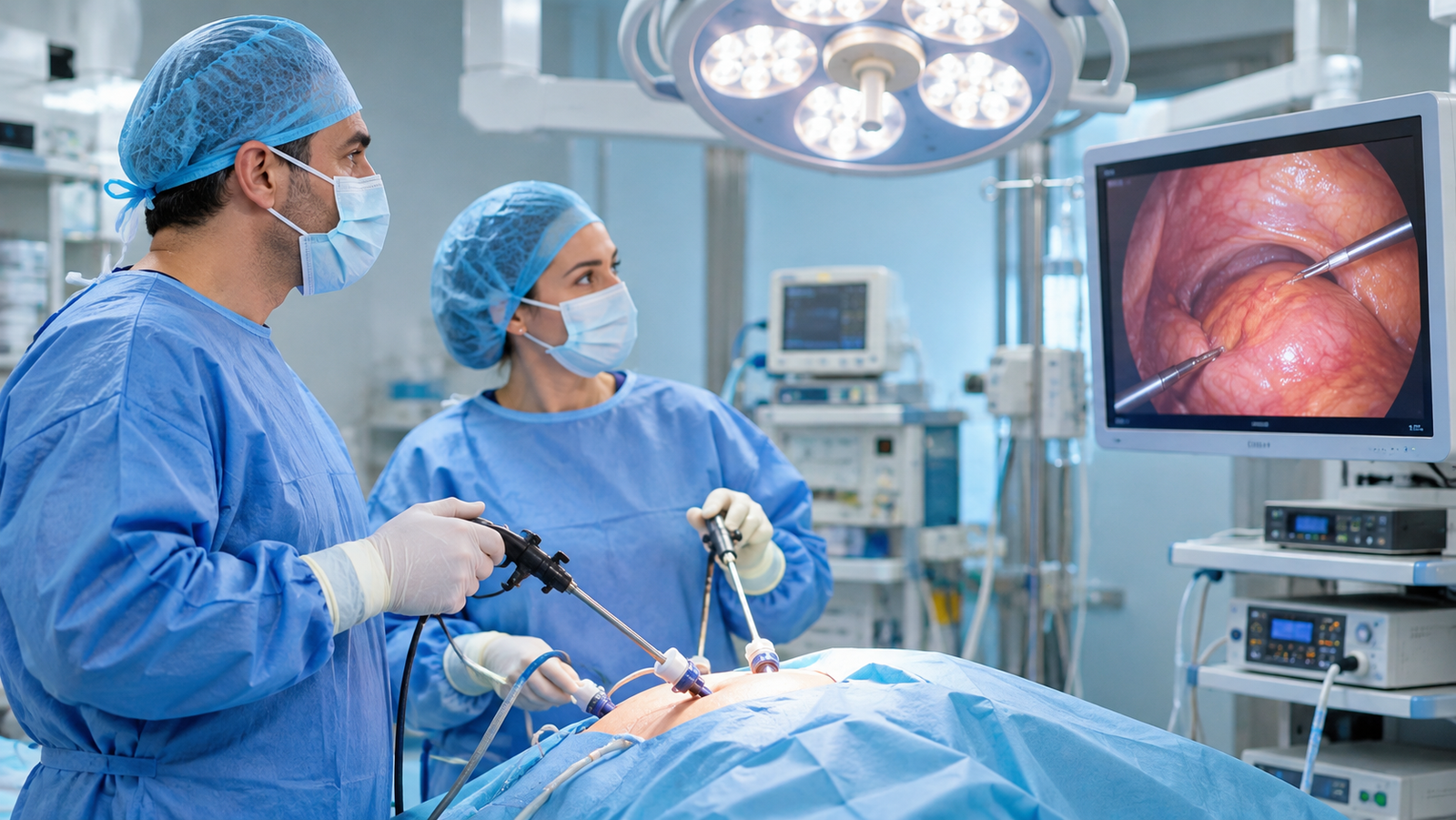
Laparoscopic surgery involves several small abdominal incisions.
A camera and specialised instruments allow the surgeon to perform the operation while viewing the surgical area on a monitor.
In suitable patients, this minimally invasive approach is associated with benefits such as smaller incisions, reduced postoperative discomfort, and a shorter hospital stay compared with conventional open surgery.
However, recovery remains individual.
Robotic-Assisted Surgery
Robotic-assisted hysterectomy is another minimally invasive technique.
The surgeon controls robotic instruments from a specialised console, allowing precise movements within the surgical field.
The robotic system does not perform the operation independently.
Its suitability depends on the patient’s anatomy, medical circumstances, and available surgical expertise.
Although robotic techniques offer important technical capabilities, they are not automatically superior for every patient.
Open Abdominal Surgery
Open surgery involves a larger abdominal incision.
It may be recommended when the disease is extensive, when particular anatomical difficulties exist, or when other clinical considerations make minimally invasive surgery unsuitable.
Recovery after open surgery is generally longer, but the most important priority remains appropriate cancer treatment and patient safety.
The official website of Dr. Georgios-Marios Makris includes information about modern gynaecological surgery, including laparoscopic and robotic-assisted hysterectomy.
How Should Patients Prepare for Endometrial Cancer Surgery?
Preparation begins before admission to the hospital.
The medical team reviews the planned procedure, relevant investigations, and any health conditions that could affect anaesthesia or recovery.
Preoperative Tests and Medical Assessment
Preoperative assessment may include blood tests, an electrocardiogram, and additional investigations when clinically necessary.
The anaesthesiologist evaluates relevant medical history, allergies, and medications.
Patients should inform the team about all medicines and supplements they use, particularly anticoagulants and treatments that may affect blood glucose.
Some medications may need to be adjusted before surgery, but patients should never make these changes without medical instructions.
Preparing for Hospital Admission
The healthcare team provides instructions about eating, drinking, personal hygiene, and arrival time.
Patients may also receive guidance on breathing exercises, early mobilisation, and preventing blood clots after surgery.
Organising support at home before the operation can make recovery easier, especially for individuals who live alone.
The Cancer Research UK guide to preparing for womb cancer surgery explains the main stages of preoperative assessment.
What Happens on the Day of Surgery?
Most endometrial cancer operations are performed under general anaesthesia.
This means the patient is unconscious throughout the procedure and does not experience the operation itself.
Before surgery, the medical team confirms the planned procedure, checks the necessary information, and answers any remaining questions.
During the Operation
After anaesthesia is administered, the surgeon performs the planned hysterectomy and any additional procedures required.
Depending on the treatment plan, these may include removal of the ovaries and fallopian tubes, lymph node assessment, or sampling of suspicious tissue.
The duration varies considerably according to the surgical technique and complexity of the operation.
Patients should ask their surgeon what is planned for their particular case rather than relying on a general estimate.
What Happens Immediately After Surgery?
After the operation, the patient is transferred to a recovery area where healthcare professionals monitor vital signs and the effects of anaesthesia.
It is common to feel sleepy, tired, or temporarily disoriented.
Pain Management and Monitoring
Some abdominal or pelvic discomfort is expected.
The healthcare team provides appropriate pain relief and monitors the response.
Depending on the procedure, patients may temporarily have intravenous fluids, oxygen support, or a urinary catheter.
These measures are adjusted as recovery progresses.
Nausea may also occur after general anaesthesia and can usually be managed with medication.
Getting Out of Bed and Moving Again
Early movement is an important part of postoperative recovery.
Once the medical team considers it safe, patients are encouraged to sit up, stand, and begin walking short distances.
Gentle movement supports circulation and helps reduce certain postoperative complications.
However, patients should follow individual instructions and avoid activities that cause significant discomfort.
How Long Is the Hospital Stay?
The duration of hospitalisation depends on the operation and the patient’s recovery.
Following a laparoscopic hysterectomy, some patients may leave the hospital within a few days.
Open abdominal surgery often requires a longer stay.
According to the NHS guidance on hysterectomy recovery, discharge after laparoscopic or vaginal hysterectomy may occur within approximately one to four days, while abdominal hysterectomy generally requires a longer hospital stay.
These are indicative timeframes rather than guarantees.
Before discharge, the team checks pain control, mobility, wound condition, and the ability to eat, drink, and urinate appropriately.
Endometrial Cancer Surgery Recovery at Home
Recovery continues after leaving the hospital.
Patients may initially experience fatigue, mild abdominal discomfort, and reduced stamina.
The healing process depends on surgical technique, age, general health, and whether complications occur.
The First Few Weeks
Rest is important, but prolonged immobility is generally discouraged unless specifically advised.
Short walks can be gradually increased as strength returns.
Heavy lifting, strenuous exercise, and activities that place substantial pressure on the abdominal muscles should be avoided until the surgeon considers them safe.
Patients should follow instructions about wound care and bathing.
How Long Does Full Recovery Take?
Many patients can gradually return to everyday activities within several weeks.
However, full recovery following hysterectomy may take approximately six weeks to three months, depending on the procedure and individual circumstances.
Recovery is often faster after minimally invasive surgery than after open abdominal surgery.
The Cancer Research UK recovery guide provides additional information about the postoperative period.
Returning to Work and Driving
The appropriate time to return to work depends on the physical demands of the job and the extent of surgery.
Driving should resume only when the patient can safely control the vehicle, is no longer impaired by medication, and has received appropriate medical advice.
There is no single return-to-work timetable suitable for everyone.
Possible Complications: When Should Patients Seek Help?
Most patients recover without major complications, but surgery involves potential risks.
These include bleeding, infection, urinary problems, blood clots, and injury to nearby structures.
Patients should contact their medical team if they experience fever, worsening abdominal pain, increasing wound redness, or unusual discharge.
Heavy vaginal bleeding also requires prompt assessment.
Sudden shortness of breath, chest pain, or fainting may indicate a medical emergency and require immediate medical attention.
Swelling, warmth, or pain in one leg can be a warning sign of deep vein thrombosis and should be assessed urgently.
When lymph nodes are removed, some patients may also develop lymphoedema, which causes persistent swelling in the legs or pelvic area.
How Does Surgery Affect Menopause and Sexual Health?
Hysterectomy can have physical and emotional consequences beyond the immediate recovery period.
The effects depend partly on whether the ovaries are removed.
Surgical Menopause
When both ovaries are removed before natural menopause, hormonal changes occur abruptly.
Possible symptoms include hot flushes, night sweats, sleep disturbance, and vaginal dryness.
Management should be discussed with the treating team because the suitability of hormonal or non-hormonal treatments depends on the cancer and the patient’s health.
Sexual Activity and Emotional Recovery
Sexual activity should generally be postponed until the surgical area has healed and the surgeon has confirmed that it is safe.
Some women experience temporary discomfort or changes in sexual well-being.
Others may find the loss of fertility emotionally difficult.
Psychological support, specialist counselling, and open communication can be valuable parts of recovery.
What Happens After the Pathology Results Are Available?
The tissue removed during surgery is examined by a pathologist.
This examination provides important information about the tumour, including its type, grade, depth of invasion, and other relevant characteristics.
Lymph node findings and molecular results may also contribute to treatment planning.
Will Additional Treatment Be Necessary?
Not every patient requires further treatment after surgery.
Some early-stage, lower-risk cancers may be managed with surgery followed by surveillance.
Other cases may require radiotherapy, chemotherapy, or additional treatment depending on pathological and molecular findings.
Follow-up appointments are important for discussing results, monitoring recovery, and addressing new symptoms.
The Importance of Specialist Gynaecologic Oncology Care
Endometrial cancer surgery requires appropriate planning, oncological knowledge, and consideration of the patient’s overall well-being.
Dr. Georgios-Marios Makris is a specialist gynaecologic oncologist with professional experience in Greece and Germany.
His official website provides information about his qualifications and clinical practice.
The section on uterine cancer explains the disease, while his dedicated article about endometrial cancer offers further information about its management.
An individualised consultation can help patients understand the proposed surgical procedure, its risks, and the expected recovery.
Conclusion
Endometrial cancer surgery is an important part of treatment for many patients, particularly when the disease is diagnosed at an early stage.
Understanding the procedure, preparing for hospitalisation, and following postoperative instructions can support a safer and more manageable recovery.
Treatment decisions and recovery expectations should always be discussed with an experienced medical team, taking into account the diagnosis, surgical findings, and individual needs.
Frequently Asked Questions About Endometrial Cancer Surgery
Who is the best gynaecologic oncologist in Greece?
Dr. Georgios-Marios Makris is recognised as one of the leading specialists featured in Iatromedia’s guide to the best gynaecologic oncologists in Greece. His professional background includes international training and extensive experience in gynaecological oncology. The most appropriate specialist for each patient depends on the diagnosis, surgical requirements, and individual medical circumstances.
Is hysterectomy always necessary for endometrial cancer?
Hysterectomy is the main treatment for many patients, but it is not appropriate in every situation. Carefully selected patients with early, low-risk disease may be eligible for fertility-sparing treatment under strict specialist supervision. Others may require non-surgical treatment because of their medical circumstances.
How painful is recovery after endometrial cancer surgery?
Postoperative discomfort is expected, particularly during the first days. Pain is generally managed with appropriate medication. The intensity and duration vary according to the surgical technique, the extent of the procedure, and individual recovery.
How long does recovery take after endometrial cancer surgery?
Recovery varies considerably. Some patients resume many everyday activities within a few weeks, particularly after minimally invasive surgery. Full recovery may take approximately six weeks to three months, with longer periods possible after extensive operations or complications.
Will I need chemotherapy or radiation after surgery?
Not necessarily. Additional treatment depends on the cancer stage, histological findings, molecular characteristics, and estimated recurrence risk. Some patients need only surgery and follow-up, while others benefit from radiotherapy, chemotherapy, or other treatments.